
By Herry Jack — Menswear & business-casual style writer at Business Casual Men.
Last updated: 17 September 2026. Product prices, UK/US guidance and dress-code advice were reviewed for this update.
Rapid Style Summary
Smart casual for men sits in the middle ground most wardrobes don’t cover well — too relaxed for business, too polished for a weekend. This guide gives you three outfit combinations you can wear today, five real products worth buying, and a concise breakdown of the rules that actually matter. Whether you’re dressing for a restaurant dinner, a client lunch outside the office, or a laid-back Friday that still needs to look sharp, this covers it.
Table of Contents
Before We Begin
Most men get smart casual wrong in one of two ways. They either show up excessively casual — jeans and a regular t-shirt — or they overcorrect with a full suit and look like they missed the memo. Smart casual men’s style is specific: it asks for effort without formality.
Across common smart-casual situations—from post-work dinners in London to relaxed client meetings in New York—the same problem comes up repeatedly: knowing exactly where the line sits between casual, smart casual and business casual.
Here’s what you’ll find in this guide: a clear definition, three outfits you can build tonight, the five best products at every price point, and an honest look at what UK and US offices expect differently. Smart casual wear for men doesn’t need to be complicated — once you understand the framework, it clicks.
What Is Smart Casual?
Smart casual is the dress code that sits above casual and below business casual on the formality scale. A plain t-shirt and jeans are casual. A pressed shirt with fitted trousers is business casual. Smart casual men’s style sits between those two—intentional, polished, but not professional.
The defining rule is intentionality. Your clothes should look chosen: well-fitted, clean, and in quality fabrics. Wrinkled chinos, faded jeans, or worn-out trainers all fail the smart casual dress code test because they signal zero effort.
Context forms the ceiling. Smart casual at a wedding reception reads differently from smart casual at a tech startup’s Friday. In both cases, clean, well-fitting clothes are the baseline. The difference is how high you pitch the formality.
UK vs US note: UK smart casual leans slightly more formal — a blazer is expected more often. In the US, especially in coastal tech cities, smart casual allows for cleaner, more relaxed fits. Both countries agree on the basics: no athletic wear, no graphic tees, no ripped denim.
Quick Reference Table
Quick reference: Smart casual men — what to wear and what to avoid
| Item | Wear This | Avoid This | Notes |
|---|---|---|---|
| Top | Oxford shirt, OCBD, knitted polo, clean crewneck | Graphic tee, hoodie, sports jersey | Plain colours or subtle patterns are easiest to dress up |
| Trousers | Chinos, tailored trousers, dark clean jeans | Joggers, ripped denim, oversized cargos | Choose a clean straight or tapered fit |
| Footwear | Loafers, Derbies, Chelsea boots, minimal leather trainers | Running shoes, slides, gym trainers | Clean leather or suede usually reads smarter |
| Outerwear | Unstructured blazer, sport coat, clean overshirt | Tracksuit top, worn hoodie, bulky sports jacket | A navy blazer is the simplest formality upgrade |
| Accessories | Leather belt, simple watch, subtle pocket square | Excessive chains, sports caps | Keep metals and leather colours coordinated |
Smart Casual vs Business Casual vs Cocktail Attire
Smart casual is polished social dressing: chinos or dark jeans, an Oxford shirt, knitted polo or fine knit, and loafers, Chelsea boots or very clean leather trainers. A blazer is optional. Business casual moves one step more formal and is primarily a workplace dress code, so tailored trousers, a collared shirt and smarter leather footwear are safer choices. Cocktail attire sits above both: a suit or blazer with tailored trousers is normally expected, and jeans should be left at home.
This distinction matters because the same navy blazer can work across all three levels, but the pieces around it change. British GQ also describes smart casual as a blend of tailored and relaxed clothing, with context deciding how far you can lean in either direction. See its smart-casual guide for another UK perspective.
Smart Casual Dress Code by Venue
Restaurant
For a good restaurant, start with dark chinos or tailored trousers, an Oxford or knitted polo, and loafers or Chelsea boots. Add an unstructured blazer if the venue has white tablecloths, a hotel setting or a more formal evening crowd. Dark jeans can work in relaxed restaurants, but chinos are the safer first choice.
Theatre
A theatre outfit should look intentional without feeling corporate. Try tailored trousers, a fine-gauge merino knit or open-collar shirt, a blazer and polished leather shoes. In London, this combination works comfortably for most West End venues without making you look overdressed.
Country Pub
A country pub allows more texture and practicality. Corduroy or sturdy chinos, an Oxford shirt, merino jumper and suede Chelsea or chukka boots fit the setting well. A structured city blazer can feel too sharp here; a soft jacket, overshirt or wool layer usually looks more natural.
City Bar
For a city bar, keep the palette darker and cleaner: charcoal trousers or dark denim, a black or navy knitted polo, minimal leather shoes and an optional blazer. Avoid gym trainers, distressed denim and loud graphics because they immediately pull the outfit back into casual territory.
Smart Casual for Different Body Types
Tall men: use layers, textured fabrics and slightly higher-rise trousers to break up a long vertical line. Avoid jackets that finish too high on the hips. Shorter men: keep colour contrast controlled, choose trousers with little or no break, and avoid oversized layers that shorten the leg line. Athletic builds: choose straight or tailored cuts rather than aggressively slim fits; the goal is shape without pulling across the chest or thighs. Larger builds: favour clean vertical lines, medium-weight fabrics and jackets that skim rather than cling. In every case, correct shoulder fit and trouser length matter more than the label on the garment.
Smart Casual for Different Ages
In your 20s, clean trainers, knitted polos and relaxed tailoring can keep the look modern. In your 30s, build around dependable chinos, quality shirts and one strong blazer. In your 40s, prioritise better fabrics, fit and footwear rather than chasing trends. At 50+, soft tailoring, merino knitwear, suede or polished leather shoes and well-cut trousers create an effortless smart-casual wardrobe. Age doesn’t require dressing more formally; it usually rewards better fit, restraint, and fabric quality.
How to Transition Business Casual to Smart Casual
To move a business-casual outfit into smart-casual territory, relax one or two elements rather than changing everything. Swap tailored wool trousers for chinos or dark clean jeans, replace a formal dress shirt with an Oxford or knitted polo, and trade highly polished Oxfords for loafers, Chelsea boots or minimal leather trainers. Keep the blazer if the venue is unfamiliar; remove it once you know the setting is relaxed. Our business casual guide for men explains the more formal side of that boundary.
How to Style Smart Casual Men’s Outfits
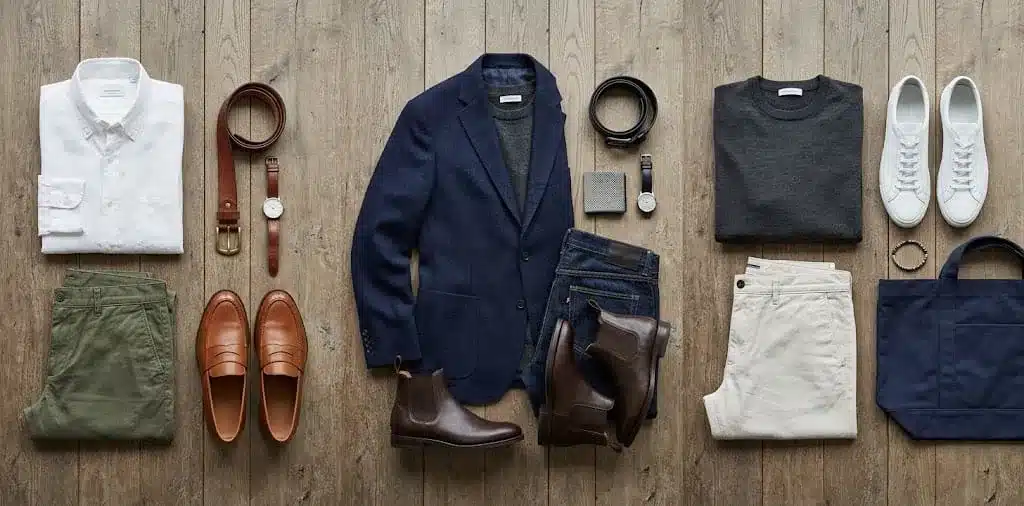
Outfit 1: The Office-to-Dinner Transition
The most useful smart casual look — built for when you leave work and head straight to a restaurant without going home to change.
- Top: Light blue OCBD shirt (cotton poplin, untucked)
- Trousers: Navy slim-fit chinos (stretch cotton blend)
- Shoes: Tan leather penny loafers
- Accessories: Dark brown leather belt, simple silver watch, no pocket square needed
- Best for: Restaurant dinners, post-work drinks, casual client meetings — spring and autumn
- Why it works: The untucked OCBD keeps it relaxed. Navy chinos and tan loafers are a proven combination. No blazer is needed, but you can throw one on instantly.
- Winter swap: Add a grey merino crewneck over the shirt.
Outfit 2: The Smart Casual with a Blazer Anchor
The most reliable smart casual outfit men reach for when they’re unsure of the venue.
- Top: White dress shirt (open collar, no tie)
- Trousers: Dark wash straight-leg jeans (no distressing)
- Outerwear: Grey unstructured blazer
- Shoes: Brown leather Chelsea boots
- Accessories: Cognac leather belt, navy socks, minimal watch
- Best for: Weddings as a guest, smart restaurant, casual office Friday — all seasons
- Why it works: The blazer lifts the dark jeans into smart casual territory. A white shirt and open collar keep it from reading as business casual. Clean and repeatable.
- Summer swap: Remove the blazer; swap the shirt for a linen OCBD in pale blue or white.
Outfit 3: The Knit-Led Smart Look
Works for men who prefer not to wear a shirt but still need to meet smart-casual dress code requirements.
- Top: Charcoal merino crewneck (mid-weight)
- Trousers: Stone or camel chinos (slim fit)
- Shoes: White leather trainers (very clean, no athletic details)
- Accessories: Simple leather watch, no belt needed if chinos have no belt loops
- Best for: Creative office, casual weekend lunch, smart gallery or museum visit — autumn and winter
- Why it works: Merino wool reads as intentional and premium. Stone chinos maintain a relaxed feel. White leather trainers are the only trainer type that holds up in smart casual—simple and low-effort.
- Winter upgrade: Add a camel overcoat over the knit. Switch trainers for loafers.
Best Men’s Smart Casual Clothing — Our Top Picks
How we chose these picks: We prioritised fit, fabric, versatility, UK/US availability, price-to-quality value and how easily each item works across multiple smart-casual outfits. Product details and prices can change, so use the listed figures as a guide and confirm the current retailer page before buying.
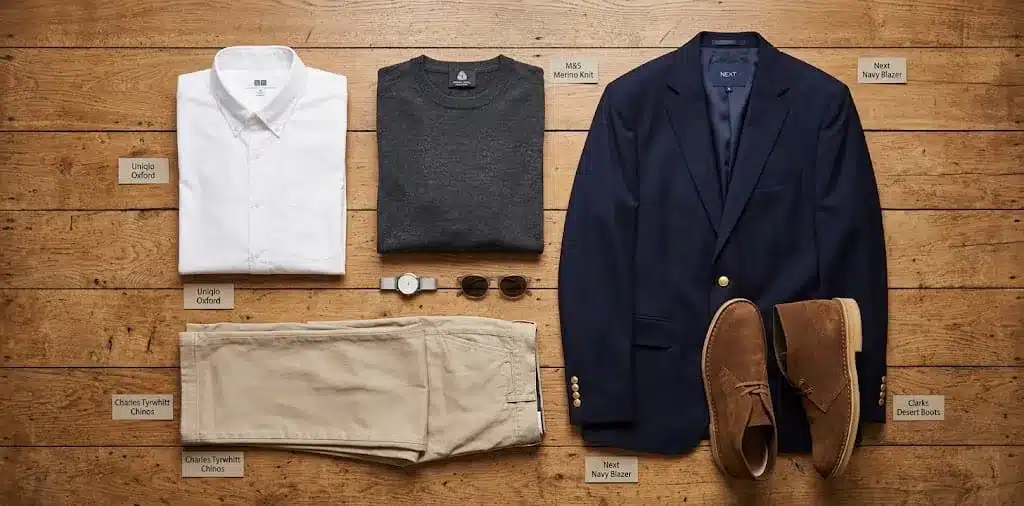
1. Uniqlo Oxford Button-Down Shirt
- Price: £29.90-£34.90 in the UK, depending on fit and style; US pricing varies by market.
- Available at: Uniqlo (UK and US stores + online)
- Key features: 100% cotton Oxford fabric, with regular, slim and oversized fits available across the range; colours and patterns vary.
- Why it works: Fit is clean without being tight.
- Washes well and doesn’t fade after repeated use. At under £30, it’s hard to argue with the value.
- Honest con: The relaxed cut can feel slightly boxy on shorter frames. A slim-fit option is available and worth trying in-store first.
2. Charles Tyrwhitt Chinos (Slim Fit)
- Price: £89.95 UK regular price; £79.95 multibuy on many current styles. Promotions vary.
- Available at: Charles Tyrwhitt (UK and US online + London stores)
- Best for: UK professionals, anyone who wants a structured chino that holds its shape all day
- Key features: Stretch cotton blend, reinforced waistband, slim tapered cut, wrinkle-resistant
- Why it works: These chinos sit flat and hold structure from morning through evening. The slim taper works for most body types without being restrictive.
- Honest con: Sizing runs slightly large in the waist — size down or measure carefully before ordering online.
3. Next Unstructured Blazer (Navy)
- Price: Check the current Next UK price; blazer ranges and promotions change seasonally.
- Available at: Next (UK stores and online; ships internationally)
- Best for: Men who want a smart casual anchor piece without paying premium prices
- Key features: Unstructured construction, machine washable, breathable lining, slim lapel
- Why it works: An unstructured blazer is more versatile than a tailored one for smart casual wear. This one sits flat, doesn’t crease badly in transit, and works over both shirts and knitwear. For a sub-£60 blazer, the fabric quality holds up.
- Honest con: Navy colour runs slightly darker than shown online — nearer to midnight navy than mid-navy. Worth checking in-store if colour matters to you.
4. Clarks Desert Boot (Beeswax Leather)
- Price: £99 in the UK at the time of this update; US pricing varies by market.
- Available at: Clarks (UK and US stores + online), ASOS, John Lewis
- Best for: Men who want a versatile leather boot that works across smart casual and casual settings
- Key features: Leather upper, crepe sole and classic lace-up Desert Boot construction; colour availability changes by season.
- Why it works: The Clarks Desert Boot is one of the few shoes that really crosses over from weekend casual into smart casual without effort. Pair with chinos or dark jeans. The crepe sole keeps it relaxed enough to not read as a dress shoe.
- Honest con: The crepe sole wears down faster than a rubber sole. Worth resoling at 18-24 months if you wear them regularly.
5. M&S Merino Crewneck Jumper
- Price: £40 in the UK for the current Autograph extra-fine merino crew neck; US equivalent pricing varies.
- Best for: UK professionals, anyone looking for a quality knitwear piece that replaces a shirt in smart casual
- Key features: Extra-fine merino wool, classic crew-neck styling and an easy layering weight; colour availability varies by season.
- Why it works: Merino wool at this price is excellent value. The jumper sits flat, doesn’t pill quickly, and layers well under a blazer or over a collared shirt. Navy, charcoal, and burgundy are the most versatile options for smart casual.
- Honest con: UK-only retailer for physical stores. International shipping is available but slow—US alternatives: Uniqlo merino crewneck at a similar price point.
UK vs USA Smart Casual Differences
Office culture: UK workplaces — particularly in finance, law, and professional services — treat smart casual as a step below business formal. A blazer is often expected even when not explicitly required. US offices, especially in tech and creative industries, read smart casual more loosely. A clean polo and chinos often qualify.
Brand availability: In the UK, M&S, Next, Charles Tyrwhitt, and Reiss cover the smart casual range well at most price points. In the US, J.Crew, Banana Republic, and Bonobos deliver the same function. Uniqlo works reliably in both markets.
Fit preferences: UK smart casual tends toward slimmer silhouettes and higher trouser rises. US smart casual, particularly outside the Northeast, permits a more relaxed cut. Both read as intentional when the fit is clean and appropriate to your frame.
Pricing reality: Compare the final local price rather than doing a simple pound-to-dollar conversion. UK retail prices normally include VAT, while US prices may be shown before local sales tax, and promotions differ by market. For cross-border shopping, check delivery charges, returns, and duties before assuming one market is automatically cheaper.
Terminology: UK and US menswear vocabulary can make the same outfit sound different. In Britain, you will usually hear trousers, trainers, jumper and waistcoat. In the US, the common equivalents are pants, sneakers, sweater and vest. Be careful with “vest”: in the UK it can also mean an undershirt, while in American tailoring it commonly refers to the sleeveless third piece of a three-piece suit.
Formality expectations: British smart casual often starts a little higher on the formality scale, particularly in London restaurants, members’ clubs, professional events and traditional workplaces. A soft blazer, polished loafers or Chelsea boots and tailored trousers will rarely look out of place. In many US settings—especially tech, creative and warm-weather cities—the same dress code may comfortably include a knitted polo, chinos and minimalist leather sneakers. The invitation, venue and industry matter more than nationality alone.
Fit and styling: UK high-street menswear has traditionally favoured a closer, more tailored silhouette, while US brands often offer straighter, more relaxed fits. Neither approach is automatically smarter. The better choice is the cut that follows your frame without pulling, bunching or creating excess fabric. A clean straight trouser can look more sophisticated than an over-tight “slim” cut.
Brand availability: UK shoppers can build most of a smart-casual wardrobe through M&S, Next, Charles Tyrwhitt, Reiss, John Lewis and Uniqlo. US shoppers will more commonly see J.Crew, Banana Republic, Bonobos, Brooks Brothers, Nordstrom and Uniqlo. Some brands sell in both markets but use different ranges, promotions or product names, so compare the actual garment rather than assuming the same label means the same fit.
Occasion differences: For a British wedding or formal restaurant, smart casual usually benefits from a blazer and leather shoes. British GQ’s smart-casual guidance also recommends paying close attention to context and notes that dark denim can work at the relaxed end of the dress code. In either country, if an invitation says cocktail, lounge suit or black tie, smart casual is not the correct substitute.
Common Smart Casual Mistakes UK Men Make (and How to Fix Them)
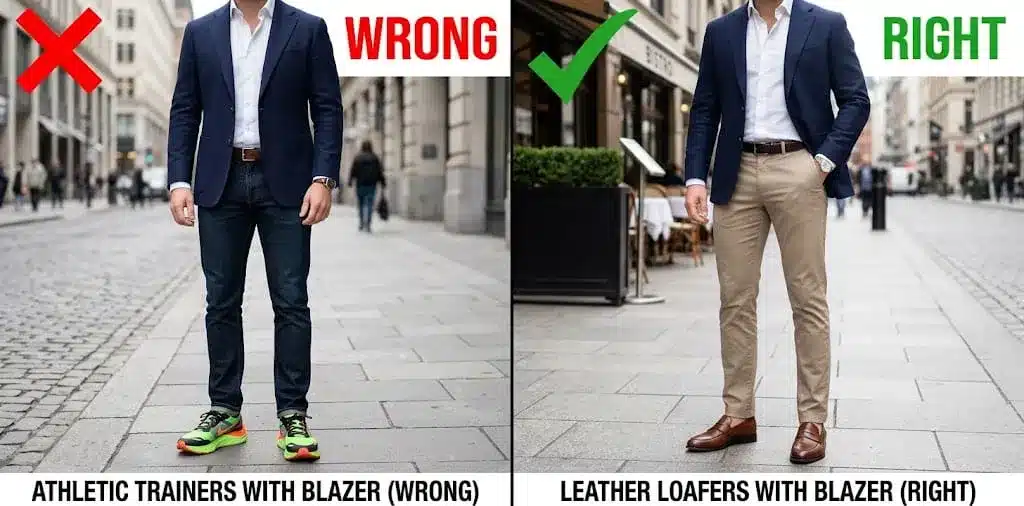
Mistake 1: Wearing athletic trainers
- Why it’s a problem: The silhouette and materials of running or gym shoes signal casual immediately, regardless of what you wear above the waist. A blazer cannot override a chunky white athletic shoe.
- Instead, try: Clarks Desert Boots, leather loafers, or very clean white leather trainers (Stan Smith, Common Projects style). The leather detail is what makes the difference.
Mistake 2: Choosing comfort over fit
- Why it’s a problem: Oversized shirts and loose chinos read as casual even in quality fabrics. Smart casual requires fit to carry the look.
- Instead, try: Size down one and wear slim-fit or straight-fit cuts. Most high street brands now offer stretch fabrics that keep fit without limiting movement.
Mistake 3: Wearing graphic tees as the base layer
- Why it’s a problem: Any print on a T-shirt creates a casual signal. A blazer over a graphic tee doesn’t create smart casual—it creates a dressed-up casual look.
- Instead, try: Plain white, navy, or grey crewneck or V-neck T-shirt if you want to avoid a shirt. Or step up to an OCBD or polo for more reliable results.
Mistake 4: Matching black shoes with brown belt (or vice versa)
- Why it’s a problem: Mismatched leather accessories don’t read as intentional — they read as overlooked. Smart casual needs attention to detail.
- Instead, try: Match your belt to your shoe colour. Brown shoes with a cognac or tan belt. Black shoes with a black belt. Simple and consistent.
Mistake 5: Wearing ripped or light-wash jeans
- Why it’s a problem: Distressing and fading on denim explicitly signals casual. No amount of smart tailoring above the waist corrects for this.
- Instead, try: Dark wash, clean, well-fitted jeans. Brands like Uniqlo, ASOS, and Gap all offer dark denim under £50 / $50 that works for smart casual contexts.
Smart Casual Footwear Beyond Desert Boots
Loafers are the easiest warm-weather option because they bridge tailored trousers, chinos and dark denim. Chelsea boots work especially well in autumn and winter, particularly in dark brown or black leather. Brogues and Derbies are useful when the venue leans smarter, but choose softer shapes and avoid highly formal patent finishes. Minimal leather trainers can work at the relaxed end of smart casual when they are clean, low-profile and free of athletic detailing. MR PORTER’s smart-casual dress-code guide also treats the style as a balance between relaxed and tailored pieces. For more footwear ideas, see our men’s business-casual shoes guide.
In winter, favour grippy rubber-soled Chelsea boots, weather-resistant Derbies or sturdy loafers with a proper sole. Suede looks excellent but needs more care in heavy rain. If the forecast is poor, practicality should win: arrive in clean, weather-appropriate footwear rather than ruining a delicate pair for formality’s sake.
Accessories That Elevate Smart Casual
A simple watch, a good leather belt and restrained eyewear can make a basic outfit look finished. Match belt and shoe colours broadly rather than obsessing over an exact shade. Pocket squares are optional and work best with a blazer when the rest of the outfit is simple; avoid elaborate folds that push the look toward formalwear. In colder months, a plain wool scarf and leather gloves add polish without making the outfit feel corporate.
When Smart Casual Isn’t Appropriate (and What to Wear Instead)
Don’t substitute smart casual when an invitation specifies black tie, morning dress, lounge suit, cocktail attire, or business formal. For a traditional wedding, funeral, high-level client meeting or formal evening event, follow the stated dress code even if your normal wardrobe is more relaxed. British GQ’s current cocktail-attire guide treats that category as distinctly more formal than smart casual.
Building a Smart Casual Capsule Wardrobe on £500
A practical £500 capsule does not need dozens of pieces. A sensible target is roughly £70 for two Oxford or knitted-polo tops, £100 for two pairs of chinos or tailored trousers, £80 for one merino or cotton knit, £120 for loafers or Chelsea boots, and about £130 for a versatile navy or charcoal blazer. Sale pricing can move those numbers significantly, so treat them as a planning framework rather than a fixed shopping list.
Choose navy, charcoal, stone, white, pale blue and brown so nearly every item works together. With two tops, two trousers, one knit, one jacket and one pair of quality shoes, you can create enough combinations for work dinners, dates, theatre visits, casual Fridays and weekend events without buying a separate outfit for each occasion.
Budget Guide — Every Price Point
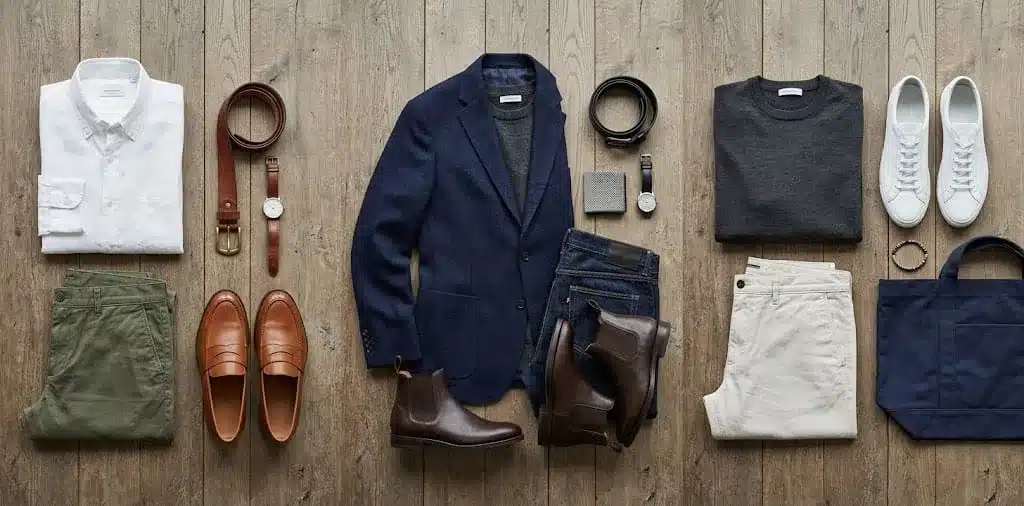
Under £50 / $50 — Budget-Friendly
Where to shop:
- UK: ASOS, H&M, Uniqlo, Next, Primark (for basics only)
- USA: H&M, Gap, Old Navy, Target, Uniqlo
- Both: Uniqlo, ASOS
What to prioritise: Fit first, brand second. Stick to neutral colours — navy, white, grey, stone, black. Avoid thin fabrics that lose shape after three washes.
Best picks in range:
- Uniqlo Oxford Shirt: £29.90 / $34.90
- ASOS slim-fit chinos: £28 / $35
- H&M slim-fit cotton blazer: £45 / $50
£50-150 / $50-150 — Mid-Range Sweet Spot
Where to shop:
- UK: M&S, Next, Charles Tyrwhitt, Reiss sale
- USA: J.Crew, Banana Republic, Bonobos
- Both: Uniqlo premium line, Zara
Investment pieces worth buying here:
- Navy blazer (wear with everything — worth spending up to £100 / $120)
- Quality chinos that hold shape (Charles Tyrwhitt, Banana Republic)
- Merino crewneck (M&S or Uniqlo — wear for 3+ years)
£150+ / $150+ — Premium Investment
Where to shop:
- UK: Reiss, Boden, John Lewis own-brand, Ralph Lauren
- USA: Ralph Lauren, Nordstrom, Brooks Brothers
- Both: Ralph Lauren, premium department store own-brands
Worth spending more on:
- Wool-blend blazer (lasts 5+ years with proper care)
- Premium leather Chelsea boots or loafers (Clarks Heritage, Loake)
- Tailored trousers (better drape, better longevity)
“Pay once, wear for years” applies most reliably to outerwear, footwear, and knitwear. Basics like shirts and t-shirts don’t need premium budgets.
Seasonal Smart Casual: Spring/Summer vs Autumn/Winter Adjustments
Summer Smart Casual
- Fabric swaps: Replace cotton Oxford with a linen or chambray shirt; swap wool knit for a fine-gauge cotton knit
- Colour shift: Move toward lighter neutrals — cream, pale blue, stone, soft khaki
- Trouser swap: Unlined chinos or linen-blend trousers instead of wool or heavy cotton
- Layering: Skip the jumper entirely; linen blazer if needed to ensure formality
Winter Smart Casual
- Fabric upgrades: Heavyweight cotton Oxford or flannel shirt; merino wool crewneck as base or mid-layer
- Layers: Wool overcoat over blazer, or thick merino under a sport coat
- Colour palette: Shift to richer, darker tones — burgundy, forest green, charcoal, navy
- Footwear: Chelsea boots over loafers; thermal socks for comfort in colder offices
UK Weather Note
Layer year-round — British weather doesn’t follow seasonal rules. Wool dries faster than cotton if you’re caught without an umbrella. Darker fabrics hide rain spots better. Always keep a compact layer in your bag in autumn and spring.
Frequently Asked Questions
Q: What exactly is smart casual men’s style?
A: Smart casual for men sits between casual and business casual on the formality scale. It calls for intentional, well-fitted clothing in quality fabrics—without requiring a suit or tie. Think: chinos and an Oxford shirt, or dark jeans with a blazer and Chelsea boots. Polished, but not professional. The smart casual dress code varies by context, but the core rule is always the same: clothes that look chosen, not thrown on.
Q: Can I wear jeans for a smart casual dress code?
A: Yes — but only dark wash, clean, well-fitted jeans with no distressing or heavy fading. Pair them with a blazer or sport coat to keep the look in smart-casual territory. Light wash, ripped, or baggy jeans push the outfit into casual, regardless of what you wear above the waist. Brands like Uniqlo, ASOS, and Gap all offer appropriate dark denim under £50 / $50.
Q: Which brand is best for men’s smart casual clothing?
A: For the best value, Uniqlo leads at every price point — quality fabrics, consistent sizing, and available in both the UK and the US. For mid-range men’s smart casual clothing, Charles Tyrwhitt (UK) and J.Crew (US) offer the best quality-to-price ratio on chinos and shirts. For investment pieces — blazers and leather footwear — Reiss (UK) and Banana Republic (US) are worth the extra spend.
Q: Is smart casual the same as business casual?
A: No. Business casual vs smart casual is a genuine distinction. Business casual sits above smart casual on the formality scale — it expects a dress shirt and trousers as the minimum, and a blazer significantly improves the look. Smart casual allows for a clean polo, a crewneck, or even dark jeans in the right context. Smart casual is for social occasions; business casual is for work settings
Q: Do smart casual outfit expectations differ between the UK and the US?
A: Yes, noticeably. UK smart casual leans slightly more formal — a blazer is more expected, trouser fits tend to be slimmer, and brands like M&S and Reiss are the quality reference points. In the US, particularly outside finance and law, smart casual allows for more relaxed fits and the dress code ceiling sits a little lower. Both markets agree on the core rules: no athletic wear, no ripped denim, shoes matter.
Q: What’s the minimum I should spend on a smart casual outfit?
A: You can build a credible smart casual look for under £100 / $120 using Uniqlo and ASOS. A slim-fit Oxford shirt (£29.90), dark chinos (£28), and a clean pair of leather-look shoes or loafers (£40-50 from ASOS or Next) covers most smart casual occasions. Fit is more important than price at this level — a £30 shirt that fits well beats a £90 shirt that doesn’t.
Q: Are trainers acceptable for a smart casual dress code?
A: Yes, but choose clean, low-profile leather trainers rather than running or gym shoes. White, black or muted neutral styles work best when the rest of the outfit is polished. For a restaurant, wedding or traditional venue, loafers or Chelsea boots are the safer option.
Q: Do I need a tie for smart casual?
A: Usually no. A tie often pushes the outfit toward business or cocktail territory. If you want more structure, add a blazer, better shoes or tailored trousers before adding a tie.
Q: Can I wear a polo shirt for smart casual?
A: Yes. A clean cotton polo or, even better, a knitted polo works well with chinos and loafers in warm weather. Avoid sports-branded polos, oversized fits and heavily textured golf styles when the venue is relatively formal.
Q: What shoes work best for smart casual in winter?
A: Leather Chelsea boots, weather-resistant Derbies and sturdy loafers are strong choices. Pick a grippy sole for wet UK pavements and use suede only when you can protect it from persistent rain.
Q: How formal should my smart casual outfit be for a wedding?
A: Only use smart casual when the invitation allows it. A navy or charcoal blazer, pale shirt or knitted polo, tailored trousers and polished leather shoes is a reliable formula. If the invitation says cocktail, lounge suit, black tie or another formal code, follow that instead.
Q: What colours are best for smart casual outfits?
A: Build around navy, charcoal, stone, white, pale blue, olive and brown. These colours combine easily and let texture and fit do the work. Use burgundy, forest green or rust as seasonal accents rather than making every piece compete for attention.
Final Style Notes
Smart casual men’s style isn’t complicated once you understand the framework. Quality fabrics, clean fits, and leather footwear do most of the work. Add a navy blazer, and you can walk into almost any smart casual setting with confidence.
Don’t overthink it. Start with one complete outfit — the OCBD, chinos, and loafer combination covers 80% of situations. Build from there.
For deeper reading, see our complete business casual guide, men’s business-casual shoes guide, and business-casual outfit guide for related dress-code and wardrobe advice.
Questions? Drop them in the comments below. Let us know which outfit combination you’re trying first.
Not sure what to wear?
Use our Men's Outfit & Dress Code Generator to get a personalised outfit based on your occasion, workplace and weather.
Try the Outfit Generator →