Quick Fashion Summary: This guide covers business casual men tops — the shirts, polos, and jumpers that sit between a suit jacket and a T-shirt. You’ll get specific outfit combinations, five real product picks, a UK vs USA comparison, and answers to the questions men actually search before buying. Written for office, meetings, and everyday professional wear.

Ever pulled an Oxford shirt out of the wardrobe, held it up, and thought, “Is this excessively formal?” — then grabbed a polo instead and immediately second-guessed that too? Most men have stood in exactly that spot on a Monday morning.
Business casual men tops cause more confusion than trousers or shoes, mainly because “business casual” means something slightly different depending on your office, your industry, and whether you’re in London or New York. This guide sorts through what actually works: which shirts pass, which polos read as excessively casual, and where jumpers fit into the mix.
In my experience writing about this for a few years now, the men who get this wrong aren’t dressing badly; they’re just guessing without a reference point. This gives you one.
Table of Contents
What Is Business Casual for Men?
Business casual sits in the middle of the dress code hierarchy: Formal → Business → Business Casual → Smart Casual → Casual. That generally means a collared shirt or a smart-fitting jumper, no tie required, and no jacket needed unless your office culture leans formal.
What does business casual look like for men in practice? Think Oxford shirts, chambray shirts, quality polos, and merino jumpers — never a plain crew-neck T-shirt or anything with a graphic print.
The UK and US read this slightly differently. UK offices, especially in finance and law, tend to keep business casual closer to business — shirts stay buttoned to the collar more often. US offices, particularly in tech and media, have pushed business casual closer to smart casual, where a good polo is genuinely fine.
Two secondary keywords worth noting here: is a polo business casual — yes, if it’s fitted and in a solid colour or subtle pattern. And mens business casual as a search term usually means people want the full outfit, not just tops, so this guide focuses specifically on the top half.
Quick Reference Table
| Item | Wear This | Avoid This |
| Shirt | Oxford or chambray shirt, navy or white | Novelty print or logo-heavy shirts |
| Polo | Fitted pique polo, solid colour | Baggy polo, faded colour, sports branding |
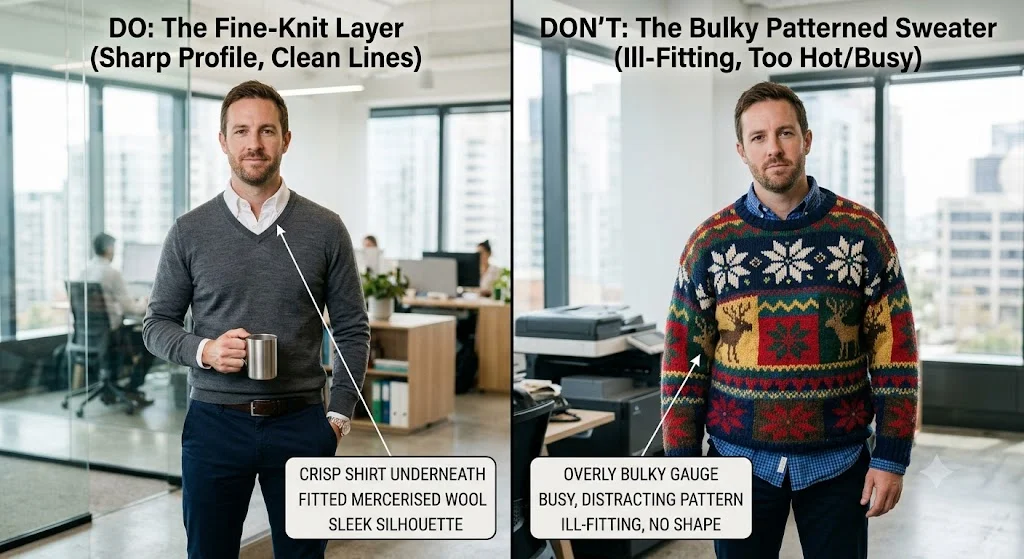
| Jumper | Merino or lambswool crew/v-neck | Chunky knit or hoodie-style jumper |
| Layering | Shirt under a lightweight jumper | T-shirt under an open shirt |
How to Style Business Casual Men Tops
Outfit 1: The Reliable Monday
- Top: White Oxford shirt, cotton
- Bottom: Navy chinos, slim-fit
- Shoes: Brown leather derbies
- Extras: Brown leather belt going with the shoes
- Best for: Standard office days, client meetings
This is the outfit I’d default to if I wasn’t sure what the day held. It reads as put-together without trying too hard, and the white Oxford shirt pairs nicely with almost any trouser colour.
Outfit 2: The Warm-Weather Polo
- Top: Navy pique polo, fitted
- Bottom: Stone chinos
- Shoes: White leather trainers (sneakers) or brown loafers
- Extras: No belt needed if the polo sits untucked
- Best for: Summer offices, Casual Friday
Outfit 3: The Smart Layer
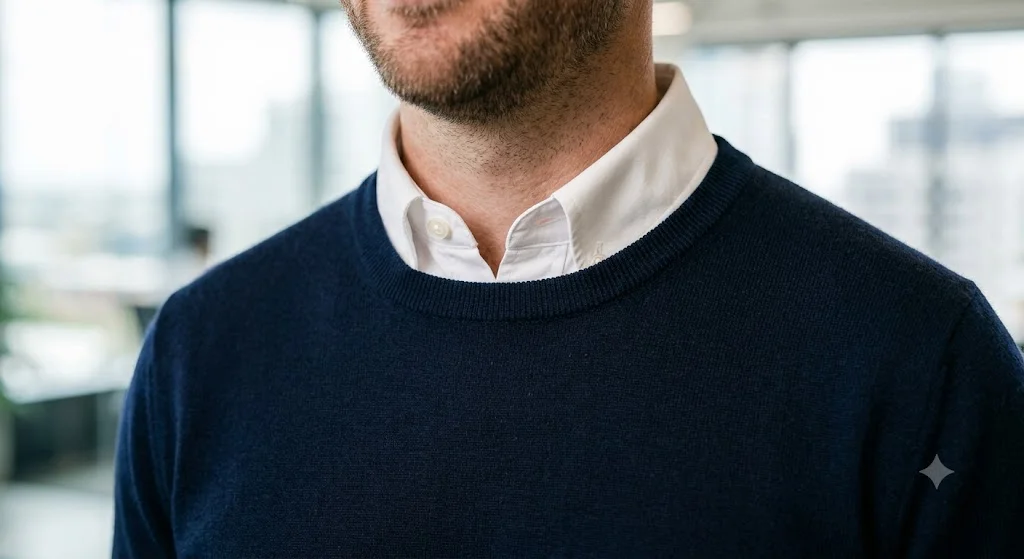
- Top: Light grey merino jumper over a pale blue shirt, collar out
- Bottom: Charcoal trousers (pants)
- Shoes: Black leather brogues
- Extras: Brown leather watch strap
- Best for: Autumn/winter office days, client-facing meetings where you want a bit more polish
This layered combination is a solid choice when you want to look slightly more put-together than a polo allows, without going as far as a full shirt-and-tie. It works well for smart business casual men settings — think consulting, sales, or client-facing roles.
Best Business Casual Men Tops — Our Top Picks
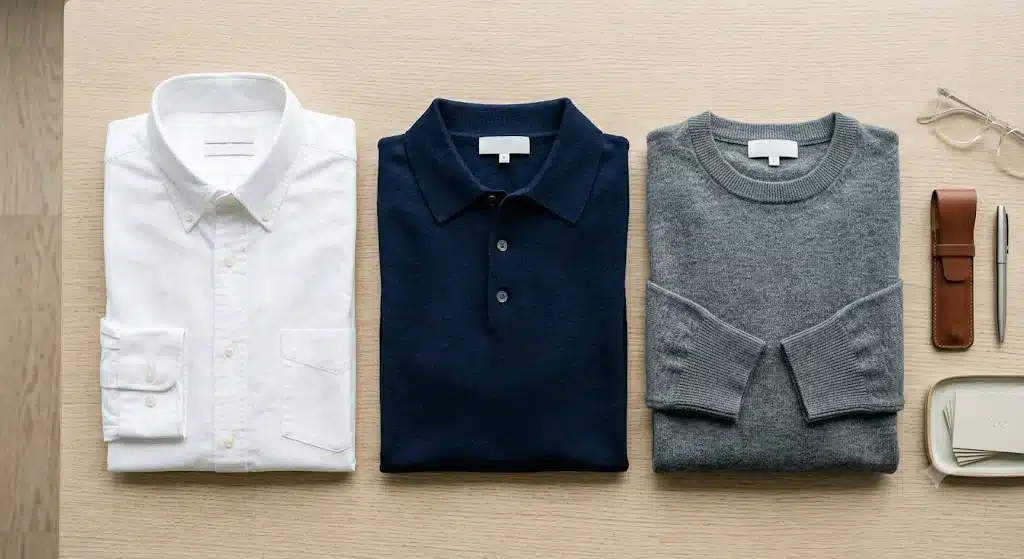
1. Charles Tyrwhitt Non-Iron Oxford Shirt
- Price: £49.50 / $65
- Best for: Everyday office wear
- Buy at: Charles Tyrwhitt
- Why it works: Holds its shape through a full day and doesn’t need ironing before you wear it, which matters more than people admit on a Monday morning.
2. J.Crew Slim-Fit Pique Polo
- Price: Check current price at J.Crew
- Best for: Warm-weather business casual, Casual Friday
- Buy at J.Crew
- Why it works: The fit is genuinely slim rather than baggy, which is where most polos go wrong for this dress code.
3. Uniqlo Merino Wool V-Neck Jumper
- Price: £39.90 / $49.90
- Best for: Layering over shirts, autumn and winter
- Buy at: Uniqlo
- Why it works: Merino wool sits thin enough to layer without bulk, and the price point makes it easy to own a few colours.
4. Reiss Slim-Fit Chambray Shirt
- Price: £98 / $128
- Buy at: Reiss
5. Banana Republic Untucked Slim-Fit Shirt
- Price: Check current price at Banana Republic
- Best for: Offices that lean smart casual
- Buy at: Banana Republic
- Why it works: Cut specifically to be worn untucked without looking sloppy, which most standard shirts aren’t.
UK vs USA Style Differences

UK offices, particularly in London finance and law, still lean toward shirts over polos for business casual men UK. A polo alone can read as underdressed in those settings, even on a Friday.
US offices, especially outside the north-east corridor, have generally normalised polos and even quality trainers (sneakers) as acceptable business casual tops and footwear.
On price: UK retailers like Charles Tyrwhitt and Reiss sit in a similar mid-range bracket to US retailers like J.Crew and Banana Republic, though currency conversion means a “£50 shirt” and a “$50 shirt” aren’t quite the same spend once you convert.
Brand availability differs too — Charles Tyrwhitt and TM Lewin are UK-first, while Bonobos and Old Navy are US-first. However, Uniqlo, H&M, and Zara operate in both markets with largely similar ranges.
Polo vs Button-Down Shirt: Which One for Business Casual?
This is the single most common tops decision men face, and it comes down to formality, industry, and how you wear it.
The formality spectrum: A button-down (Oxford or chambray) sits closer to the “business” end. A polo sits closer to “casual.” Neither is wrong for business casual — the question is which end of the dress code your office leans toward.
| Polo | Button-Down | |
|---|---|---|
| Formality | Casual end | Smart end |
| Best for | Startups, tech, creative offices, Casual Friday | Finance, law, client meetings, interviews |
| Layer under a blazer | Only if fitted and solid colour | Always works |
| Avoid when | Client-facing formal meetings, interviews | Never — it’s the safer default |
Tucked or untucked? A polo can go either way — tucked reads more “office,” untucked works if it’s cut short enough to sit at the hip and the office is genuinely relaxed. A button-down should almost always be tucked in a business casual setting; untucked only works with a straight-hem “shirt jacket” style cut specifically to be worn that way (like the Banana Republic pick above).
The simple rule: if you’re unsure which your office expects, default to the button-down. It’s harder to get wrong. Save the polo for days you already know the dress code leans relaxed.
Common Mistakes to Avoid
Mistake 1: Wearing a t-shirt under an open shirt. Why: It reads as casual, not business casual, no matter how smart the shirt is. Instead: Wear the shirt buttoned, or layer a fitted polo underneath if you want an open-collar look.
Mistake 2: Choosing a baggy polo. Why: A loose-fitting polo tends to look more like sportswear than office wear. Instead: Go for a fitted, pique-knit polo in a solid colour or subtle stripe.
Mistake 3: Ignoring fabric quality. Why: Thin, see-through shirt fabric doesn’t hold a professional look through a full day. Instead: Look for 100% cotton or a cotton-linen blend with a bit of weight to it.
Mistake 4: Skipping the iron on non-iron shirts. Why: Even “non-iron” shirts can crease in the wash if left balled up in a bag. Instead: Hang shirts immediately after washing, or give them a quick steam before wearing.
Mistake 5: Matching jumper colour to nothing else in the outfit. Why: A jumper in an unrelated colour to your trousers or shoes can look accidental rather than intentional. Instead: Stick to navy, grey, or camel jumpers — they pair nicely with almost any trouser colour.
Budget Guide — Every Price Point
Under £50 / $50:
- Shop at: Uniqlo, H&M, Old Navy
- Focus on: Basic oxford shirts and polos in solid colours.
- Best value: Uniqlo’s oxford shirts and merino jumpers both sit under this threshold
£50-150 / $50-150:
- Shop at: Charles Tyrwhitt, Reiss, J.Crew, Banana Republic
- Best quality-to-price: Non-iron Oxford shirts, pique polos
- Investment pieces: A merino jumper you’ll wear across three seasons
£150+ / $150+:
- Shop at: Reiss (higher-end lines), Nordstrom’s premium menswear floor
- Worth it for: Shirts you’ll wear weekly for years, not occasionally
- Why spend more: Fabric weight and stitching hold up to repeated washing far better at this tier.
Seasonal Notes
Summer version: Lightweight cotton or linen-blend shirts, short-sleeve shirts and polos, plus lighter colours like pale blue and stone that show less sweat through the day.
Winter version: Layer a merino or lambswool jumper over a shirt, keep the collar visible, and stick to darker tones like navy and charcoal.
UK weather note: A lightweight jumper is worth keeping at your desk year-round — UK office air conditioning and heating both run unpredictably, and a jumper solves both problems without changing the whole outfit.
Frequently Asked Questions
Q: What is business casual for men?
A: It sits between formal office wear and smart casual — think collared shirts, polos, or jumpers, paired with chinos or tailored trousers, without needing a full suit or tie.
Q: Is a polo business casual?
A: Yes, provided it’s fitted, in a solid colour or subtle pattern, and free of sports branding. A baggy or logo-heavy polo reads more casual than business casual.
Q: What are good brands for business casual men’s tops?
A: Charles Tyrwhitt and Reiss in the UK, J.Crew and Banana Republic in the US, and Uniqlo across both markets all provide dependable choices at different price points.
Q: What tops work for business casual on Casual Friday?
A: A fitted polo or an untucked chambray shirt both work well — slightly more relaxed than a Monday oxford shirt, without dropping into t-shirt territory.
Q: Are business casual men tops different in the UK vs USA?
A: UK offices generally lean toward shirts over polos, especially in finance and law, while US offices have more broadly accepted polos as standard business casual tops.
Q: What’s a good budget option for business casual men tops?
A: Uniqlo’s oxford shirts and merino jumpers both sit under £50 / $50 and hold up well for regular office wear.
Q: Should I wear a polo or a button-down shirt for business casual?
A: Default to a button-down if you’re unsure it reads more professional and works in almost every office. Save the polo for relaxed workplaces, Casual Friday, or once you’ve confirmed your office culture leans casual.
Final Style Notes
Getting business casual men tops right comes down to fit and fabric more than anything else — a well-fitted oxford shirt or a properly cut polo will carry you through most office situations. Jumpers earn their place as a layering piece, not just a winter add-on.
Worth considering: pair this with a look at business casual shoes or a wider guide to business casual outfits on the site, since tops are only half the equation.
Experiment with fit before you experiment with colour — a well-fitted plain shirt outperforms a patterned shirt in the wrong size every time. Drop a comment if there’s a specific office scenario this didn’t cover.
Not sure what to wear?
Use our Men's Outfit & Dress Code Generator to get a personalised outfit based on your occasion, workplace and weather.
Try the Outfit Generator →