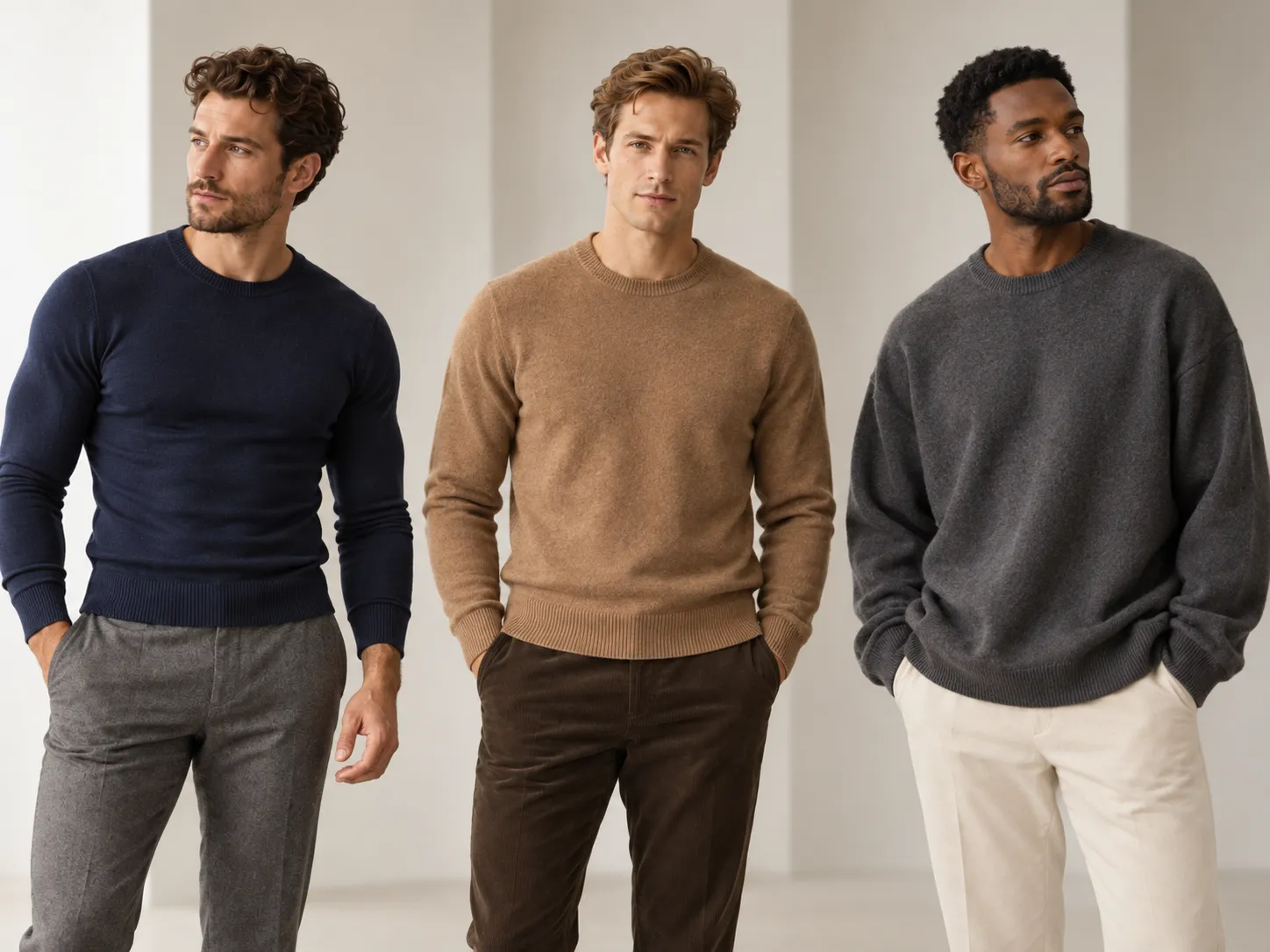
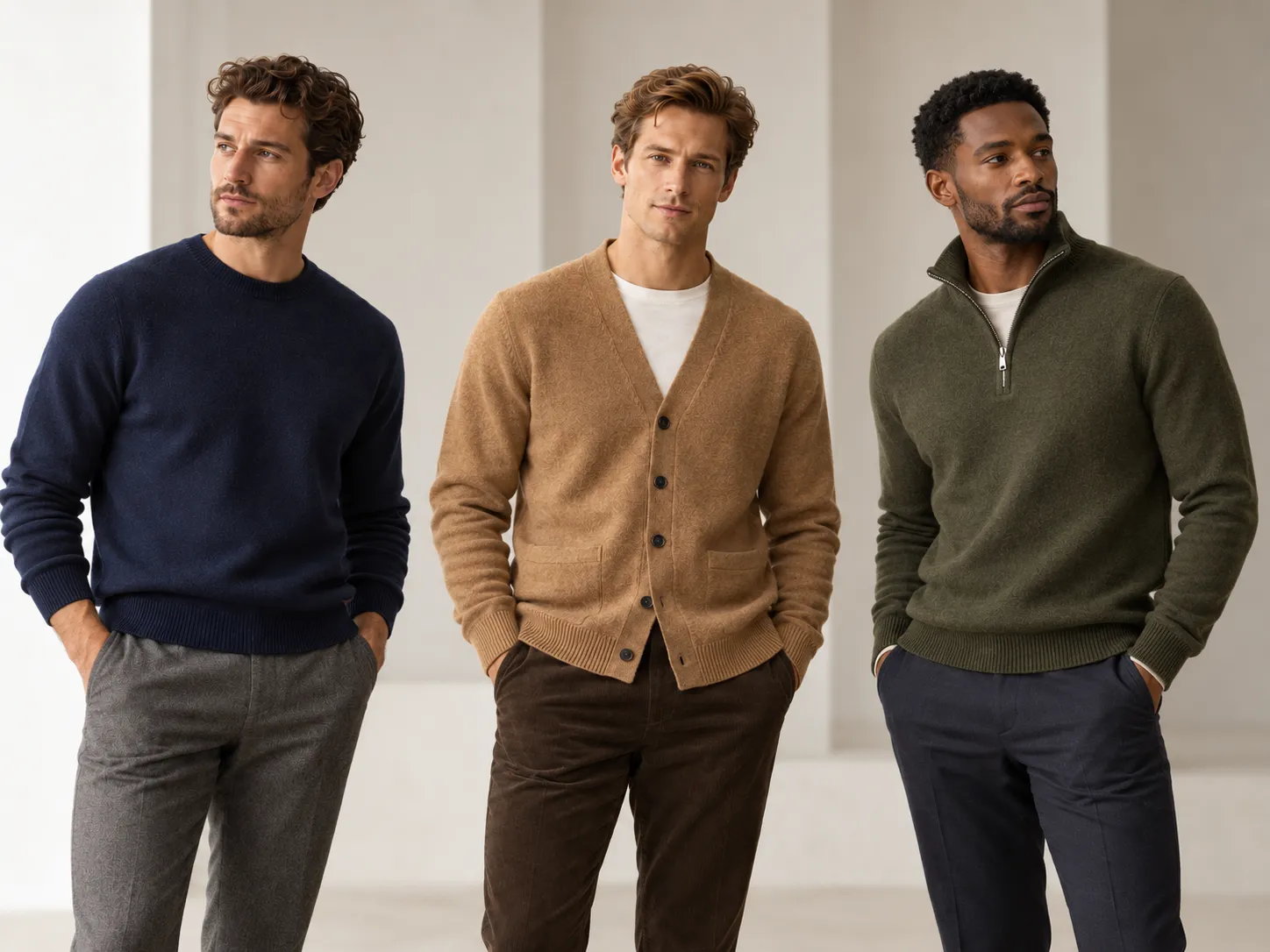
There are dozens of types of sweaters, but the names can become confusing quickly. A crewneck describes a neckline, a cardigan describes how a sweater opens, cable knit describes its texture, and merino describes the fibre. That means one sweater can belong to several categories at once. For men, the most useful sweater styles include crewnecks, V-necks, cardigans, turtlenecks, mock necks, quarter-zips, polo sweaters, cable knits and sweater vests. This guide shows you how to tell them apart, where each sits on the formality scale and how to wear it without turning your wardrobe into a collection of near-identical knitwear.
Table of Contents
Types of Sweaters at a Glance
| Sweater type | How to identify it | Best for | Formality | Under a blazer? |
|---|---|---|---|---|
| Crewneck | Round neckline | Office, everyday | Smart casual | Yes |
| V-neck | V-shaped neck | Shirt layering | Business casual | Yes |
| Cardigan | Opens at the front | Layering | Casual to business casual | Sometimes |
| Turtleneck | Tall folding neck | Winter, evenings | Smart casual | Yes |
| Mock neck | Short standing collar | Modern outfits | Smart casual | Yes |
| Quarter-zip | Short neck zip | Office, travel | Business casual | If fine-gauge |
| Half-zip | Longer front zip | Layering | Smart casual | Sometimes |
| Full-zip | Zip from hem to neck | Casual layering | Casual | Rarely |
| Polo sweater | Polo-style collar | Office, dates | Smart casual | Yes |
| Henley sweater | Short button placket | Weekends | Casual | Usually no |
| Shawl cardigan | Folded shawl collar | Winter | Smart casual | No |
| Sweater vest | Sleeveless knit | Office layering | Business casual | Yes |
| Cable-knit | Raised twisted knit | Cold weather | Smart casual | If thin |
| Aran sweater | Textured traditional-style knit | Winter | Casual | Usually no |
| Fair Isle | Multi-colour stranded pattern | Winter | Casual | Rarely |
| Argyle | Diamond pattern | Preppy outfits | Smart casual | Yes |
| Ribbed sweater | Vertical raised ribs | Minimal outfits | Smart casual | Yes |
| Waffle knit | Grid-like texture | Casual layering | Casual | Usually no |
| Raglan sweater | Diagonal sleeve seam | Relaxed outfits | Casual | Sometimes |
| Fine-gauge sweater | Thin, compact knit | Office | Business casual | Yes |
| Chunky knit | Thick yarn and texture | Cold weather | Casual | No |
| Knitted hoodie | Hooded knitwear | Weekend | Casual | No |
| Tennis sweater | V-neck with contrast trim | Preppy casual | Smart casual | Rarely |
| Intarsia sweater | Knitted-in graphic/design | Statement outfits | Casual | Rarely |
| Rollneck | UK term/style closely related to turtleneck | Winter tailoring | Smart casual | Yes |
What Is a Sweater?
A sweater is a knitted or crocheted upper-body garment, usually made from yarn. In British English, jumper is also commonly used where Americans would say sweater. You will also see pullover used for sweaters that are pulled over the head rather than opened at the front. A cardigan differs because it fastens or opens at the front. That distinction matters because sweater terminology describes different characteristics:
- Crewneck describes the neckline.
- Cardigan describes the opening.
- Cable knit describes the knitted texture.
- Cashmere describes the fibre.
- Raglan describes the sleeve construction.
So a single garment could accurately be called a cashmere cable-knit crewneck pullover.
How Many Types of Sweaters Are There?
There is no universally fixed number of sweater types. You may find articles listing 10, 20, 40 or even 50 different types because sweaters can be classified by neckline, fastening, construction, fit, knit pattern and material. For example, a men’s sweater might simultaneously be: crewneck + cable knit + merino wool + raglan sleeve + pullover. That is why simply counting every feature as a separate sweater type can make long lists look more complete than they really are. A better way to understand different sweater types is to group them by what actually changes the garment.
Types of Sweaters by Neckline
1. Crewneck Sweater
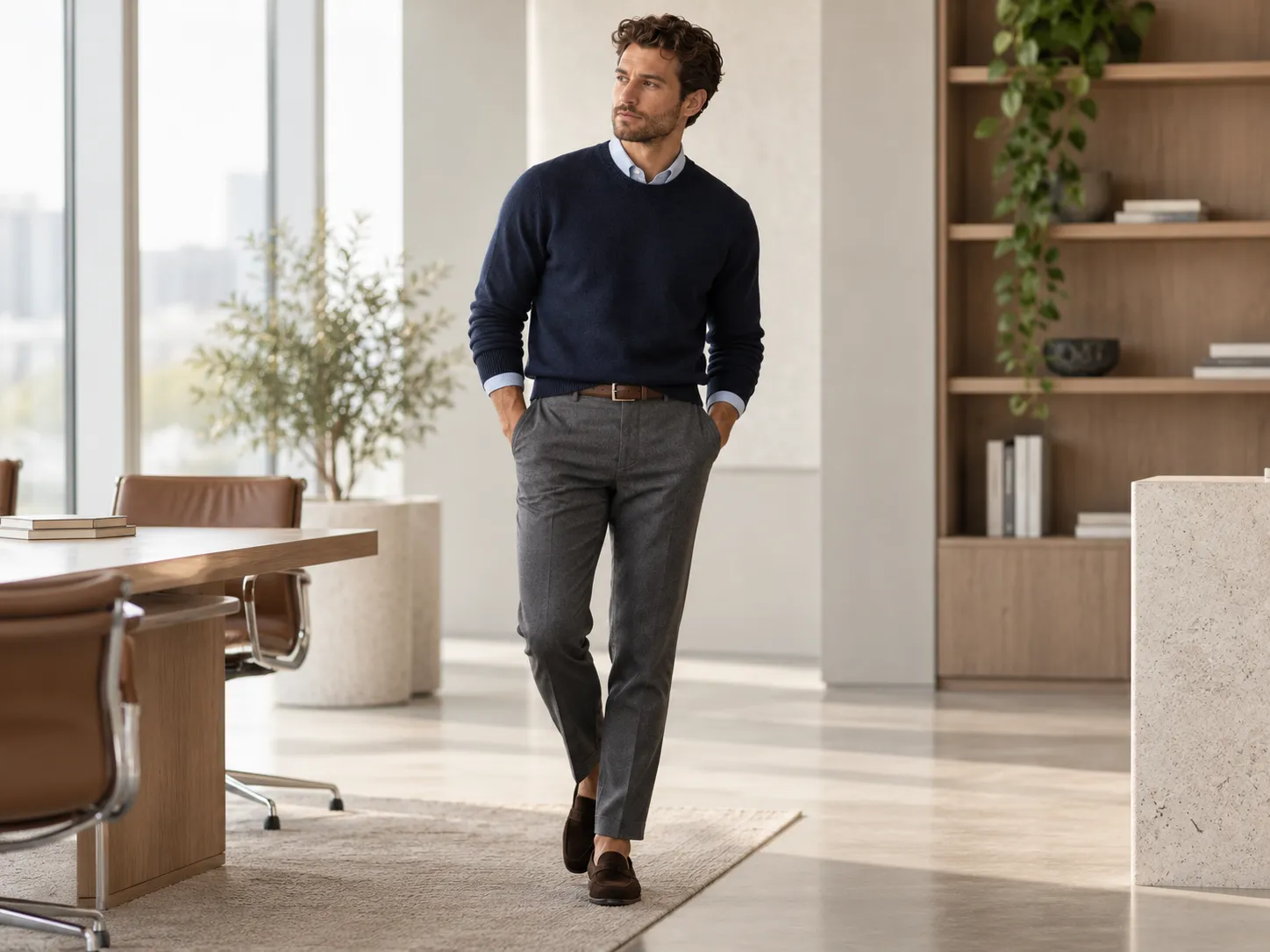
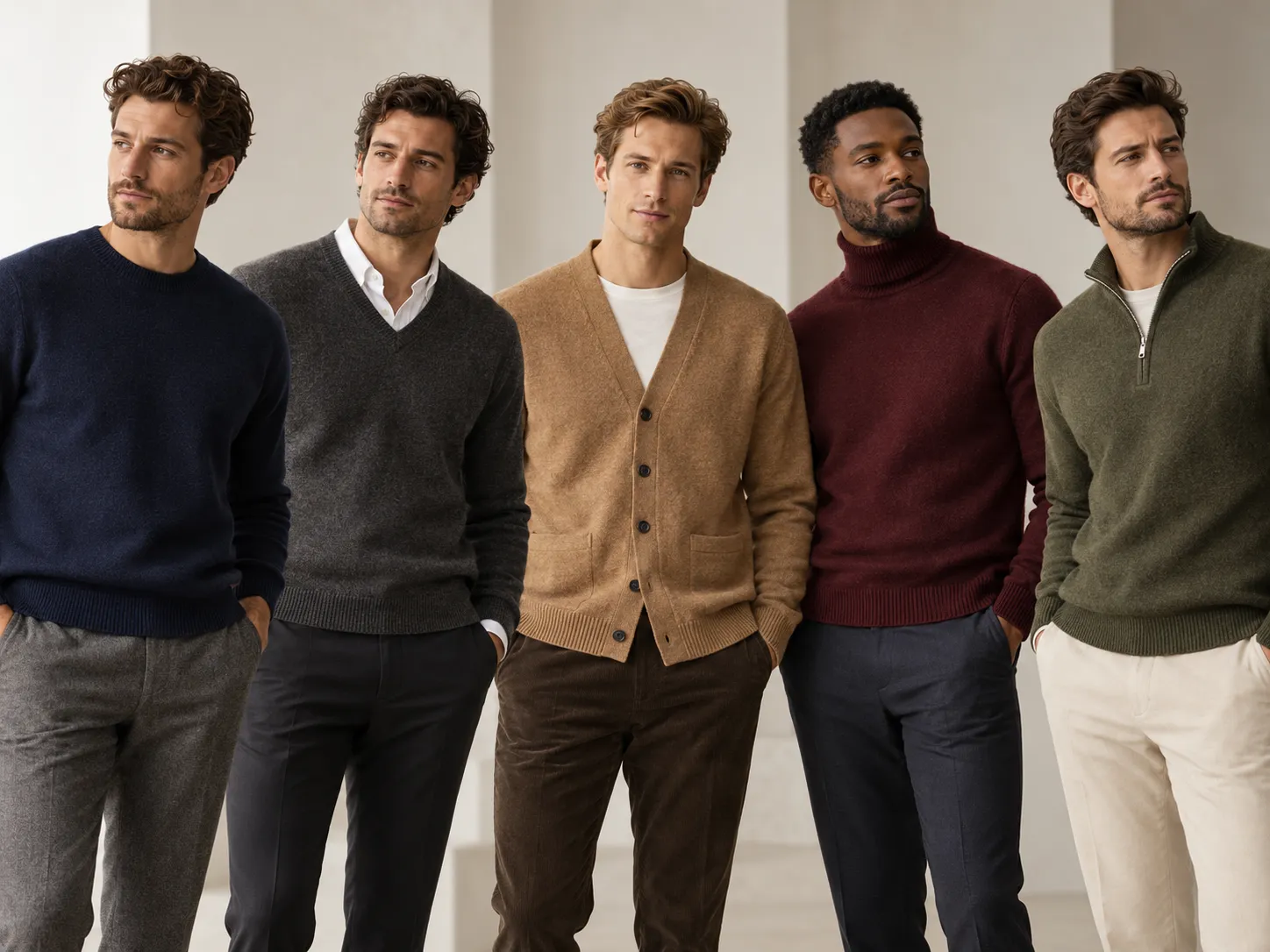
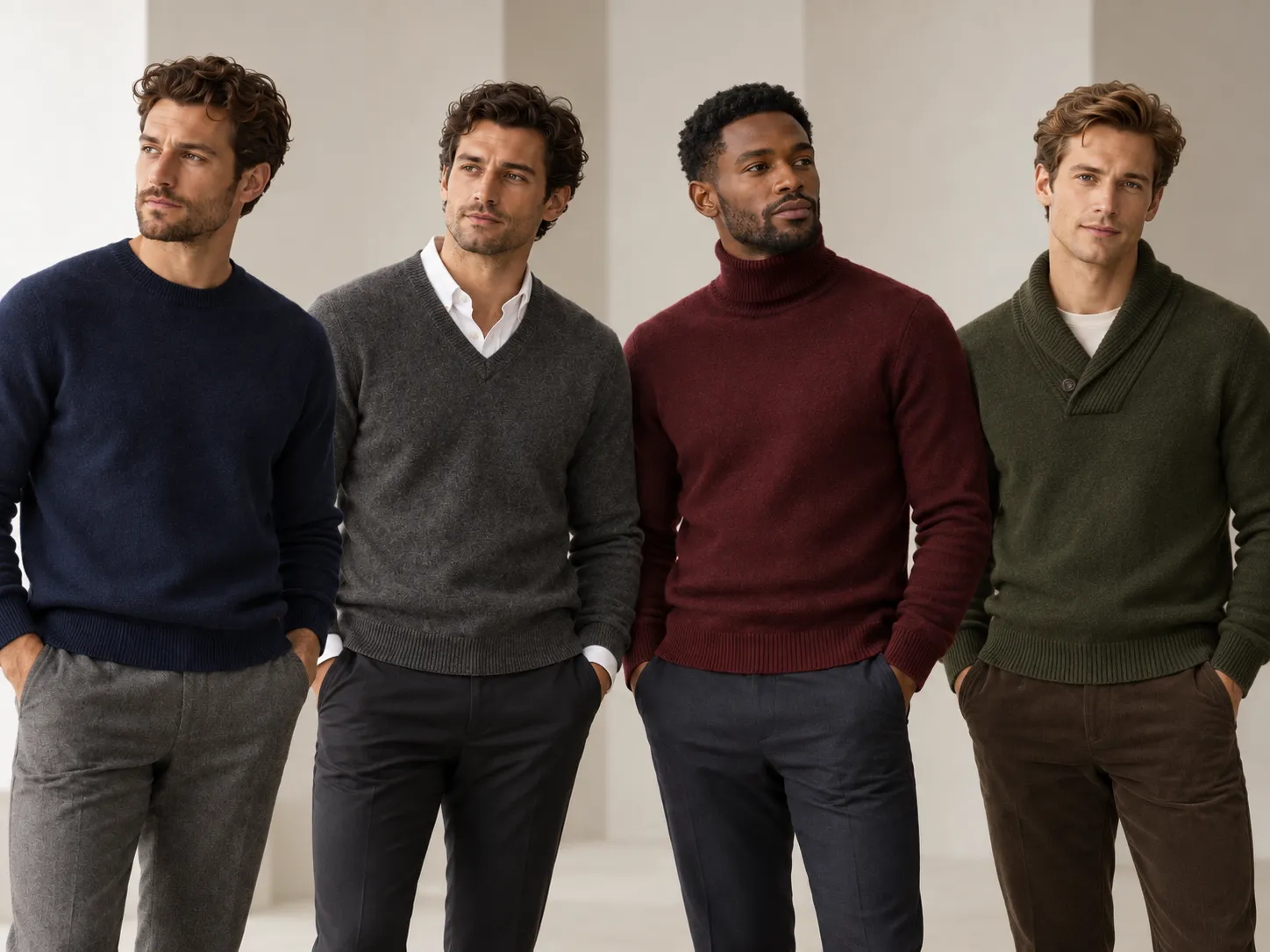
The crewneck has a simple round neckline with no collar. If you own only one jumper, this is usually the easiest shape to wear. A fine-gauge navy or charcoal crewneck works especially well for business casual knitwear because you can wear it over an Oxford shirt without creating much bulk. Best for: Office, weekends, travel. Try with: Navy crewneck + pale blue Oxford + stone chinos + brown loafers. Avoid: An undershirt collar showing around the neckline
2. V-Neck Sweater
A V-neck drops into a V shape at the chest. Its main advantage is layering. A shirt collar and tie have more room to sit naturally than they do under many crewnecks. Best for: Business casual and traditional office outfits. Try with: Charcoal V-neck + white shirt + navy trousers (pants). Watch for: A very deep V can look dated or overly casual.
Crewneck vs V-Neck
Choose a crewneck when you want a clean, modern shape. Choose a V-neck when the shirt or tie underneath is meant to remain part of the outfit.
3. Turtleneck Sweater
A turtleneck has a tall collar that extends up the neck and normally folds back on itself. A fine-gauge black, charcoal or dark brown version works particularly well beneath an unstructured blazer. Best for: Winter office wear, dinners, smart-casual events. Pair with: Wool trousers and loafers or tailored boots. Avoid: Very chunky turtlenecks beneath fitted jackets
4. Mock-Neck Sweater
A mock neck sits higher than a crewneck but usually doesn’t fold over like a full turtleneck. It gives you some of the clean lines of a turtleneck with less fabric around the neck. Best for: Minimal, contemporary outfit.s Good colours: Navy, charcoal, black, dark olive
Mock Neck vs Turtleneck
Mock neck: Shorter standing collar; normally does not fold. Turtleneck: Taller collar designed to cover more of the neck and commonly folded. This is one of the easiest sweater names to confuse when shopping online.
5. Rollneck Sweater
In UK menswear, roll neck is commonly used for the high-neck sweater Americans often call a turtleneck. Rather than artificially treating every regional name as a completely different garment, think of rollneck and turtleneck as closely overlapping terms. Best for: Autumn and winter tailoring. Try: Navy rollneck + grey flannel trousers + dark brown suede boots
Sweaters Defined by Opening and Collar
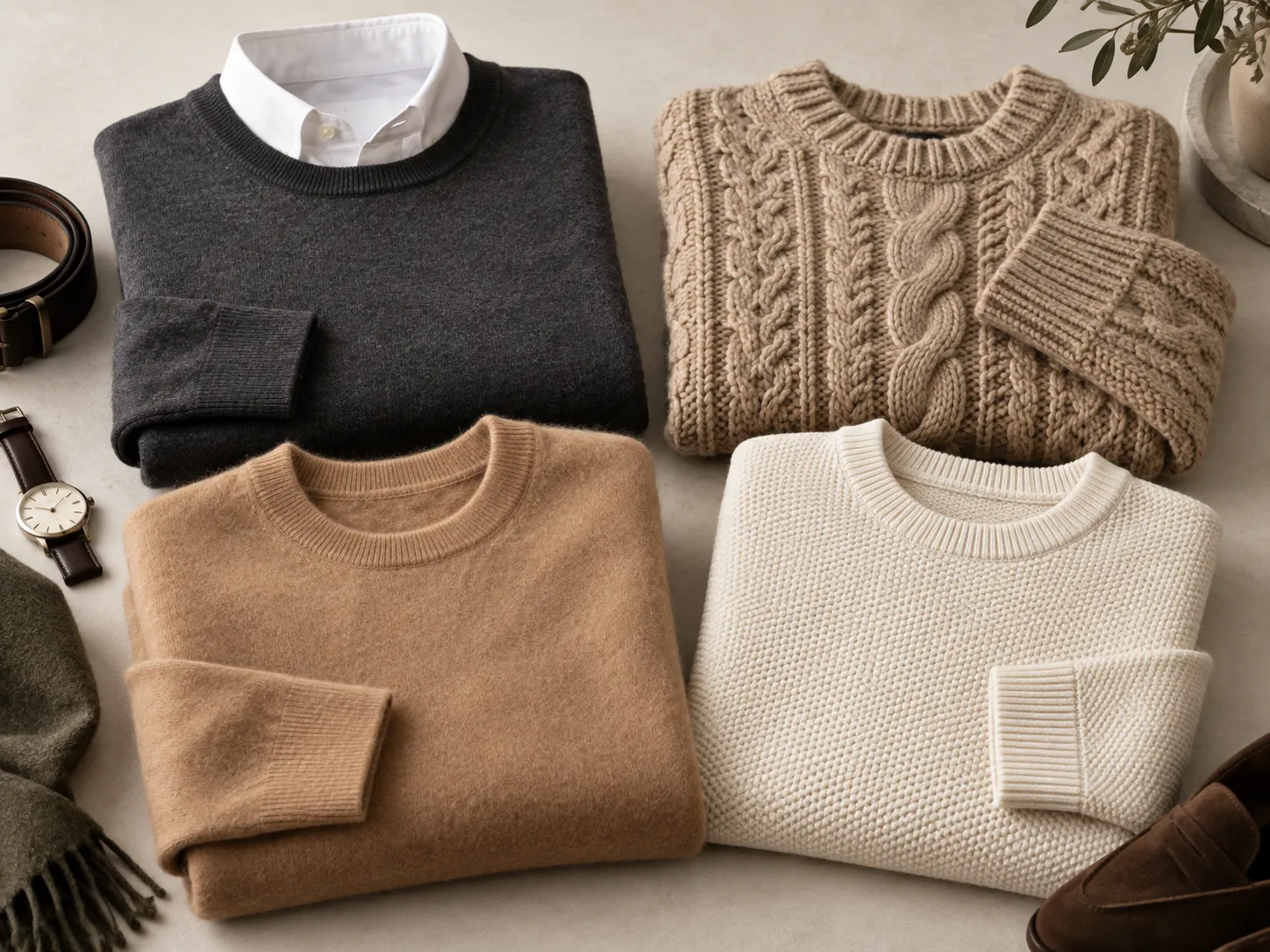
6. Cardigan
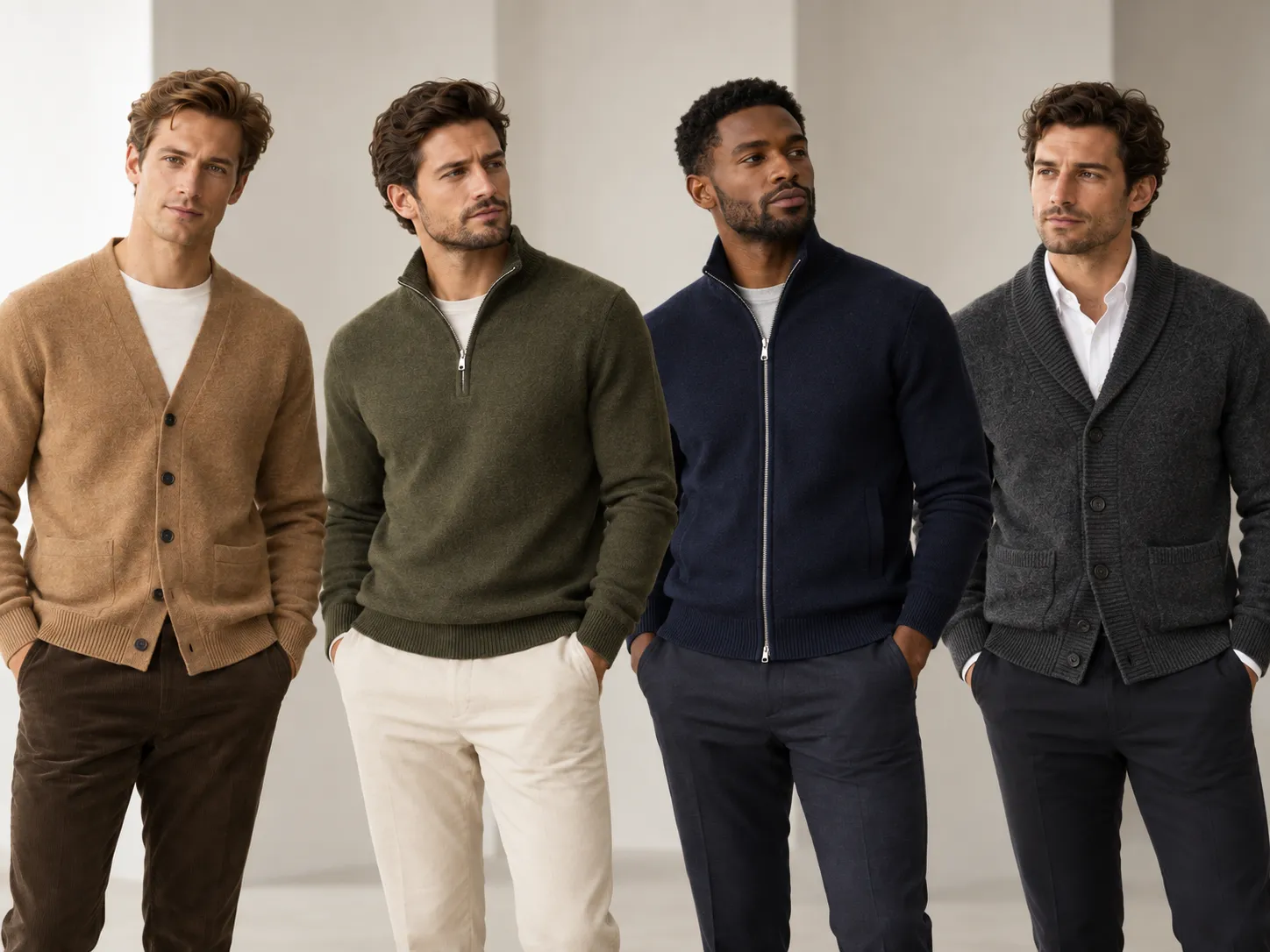
A cardigan opens at the front rather than being pulled entirely over your head. Traditional versions usually use buttons, though modern knitwear also comes in zip-front styles. A cardigan is a knitted upper-body garment that opens or fastens at the front. A fine merino cardigan can replace a blazer in relaxed offices. Best for: Layering and changing temperatures Business casual: Yes Wear with: Oxford shirt + chinos + loafers
7. Quarter-Zip Sweater
The quarter-zip has a short zip running down from the collar. It’s particularly useful in modern offices because you can wear it over either a T-shirt or a collared shirt. Best for: Office, travel, casual Friday. Smart combination: Navy quarter-zip + white Oxford + grey trousers + brown Derbies
8. Half-Zip Sweater
A half-zip jumper follows the same basic idea, but the zip extends further down the torso. It normally feels more casual and outerwear-like than a slim quarter-zip. Best for: Weekend layering and relaxed workplace.s Avoid: Thick half-zips underneath closely tailored blazers.
9. Full-Zip Sweater
A full-zip sweater opens from the bottom hem to the neck. Think of it as a knitted alternative to a lightweight jacket. Best for: Travel, commuting and casual layeri.ng Formality: Lower than a fine cardigan or crewneck
10. Polo Sweater
A polo sweater combines knitted fabric with a polo-style collar. Fine-gauge versions work when a dress shirt feels too formal, but a standard crewneck feels too plain. Best for: Smart-casual offices and dates. Wear with: Tailored trousers, chinos or dark straight-leg jeans. For a cleaner business-casual look, choose a soft collar and minimal branding.
11. Henley Sweater
A Henley sweater has a short buttoned placket but no traditional polo collar. It sits much further towards the casual end of the spectrum. Best for: Weekend outfits. Wear with: Dark jeans, cords or chinos. Skip for: Formal client meetings
12. Shawl-Collar Cardigan
A shawl cardigan has a thick rounded collar that rolls around the back of the neck and down the front. It looks more substantial than a conventional cardigan and can function almost like light outerwear. Best for: Cold weekends and relaxed winter offices. Try: Oatmeal shawl cardigan + Oxford shirt + dark denim.
13. Sweater Vest
A sweater vest is a sleeveless knitwear piece. Fine V-neck versions work over shirts; more relaxed crewneck versions work over T-shirts. Best for: Transitional weather and layered office outfits. Business casual: Yes, when the knit is neat, and the colours are restrained
Types of Sweaters by Knit and Pattern
This is where many lists become confusing. Cable knit, Fair Isle and ribbed describe how a sweater looks or is knitted. They do not necessarily describe its neckline. You can therefore have a cable-knit crewneck, cable-knit cardigan or even a cable-knit turtleneck.
14. Cable-Knit Sweater
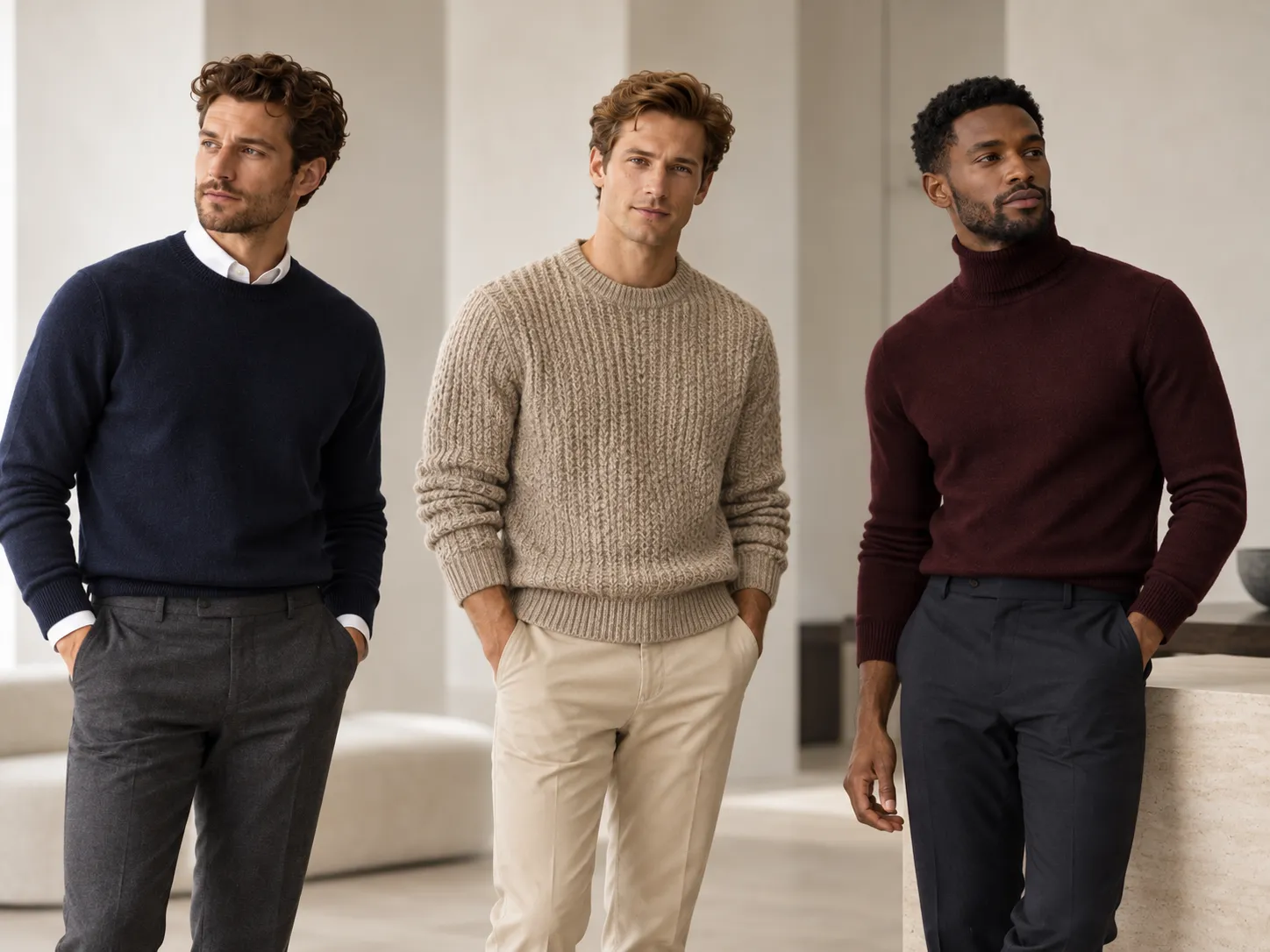
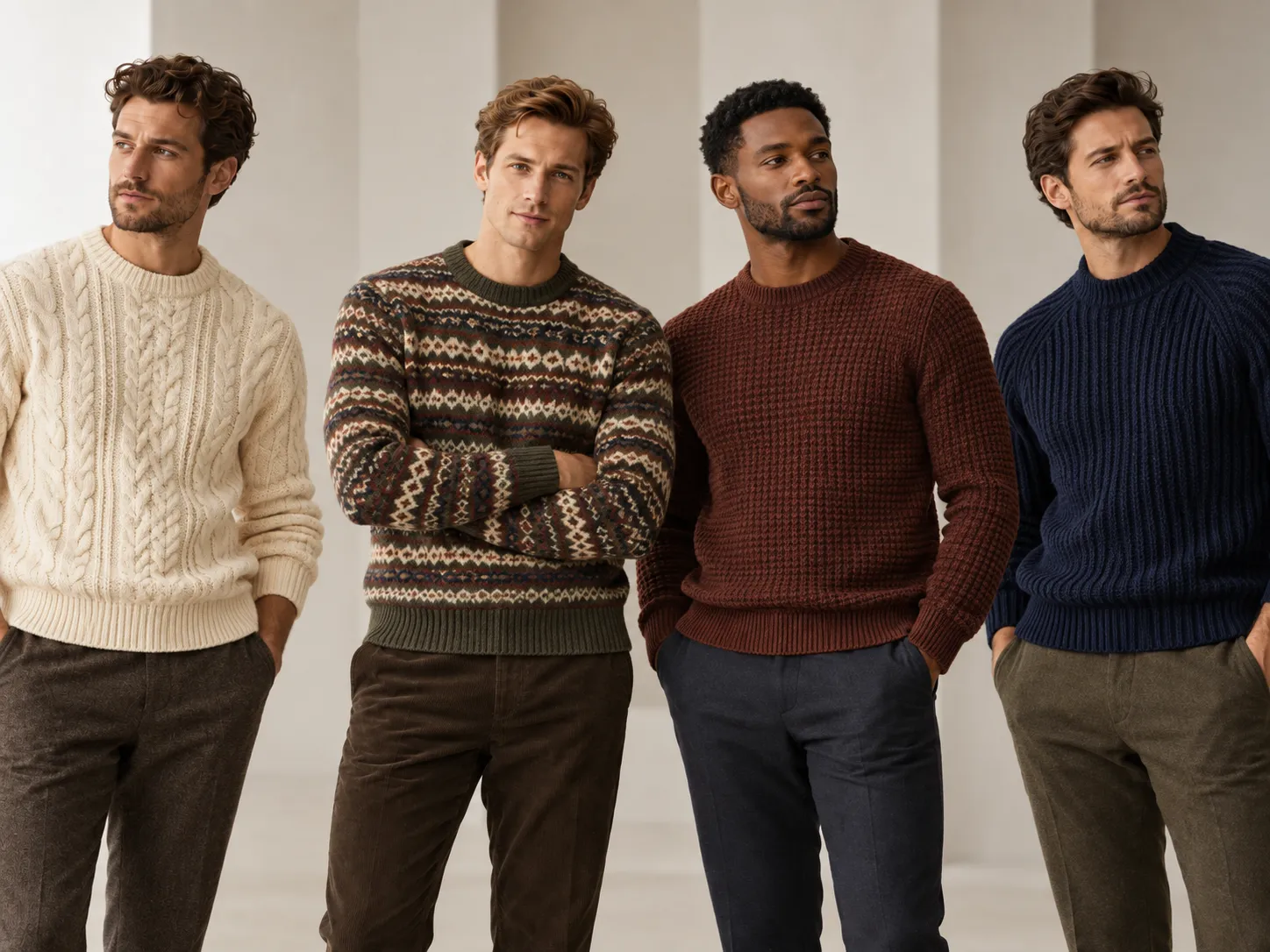
Cable knit uses raised, twisting knitted structures that resemble ropes or braids. The extra visual texture makes even a plain cream or navy sweater interesting. Best for: Autumn and winter. Formality: Casual to smart casual. Best with: Flannel trousers, chinos, corduroy, and dark denim. A chunky cable knit usually works better as the main layer rather than underneath a blazer.
15. Aran Sweater
Aran-style sweaters feature heavily textured knit patterns and commonly combine cables with other raised motifs. The key distinction is this: Cable knit is a knitting feature. Aran describes a broader sweater tradition/style that may incorporate multiple textured motifs. So not every cable-knit sweater should automatically be labelled an Aran sweater.
16. Fair Isle Sweater
Fair Isle sweaters use multi-coloured stranded patterns, often arranged in repeating horizontal motifs. Because the pattern already provides a lot of visual detail, keep the rest of your outfit quiet. Best for: Winter weekends, Christmas gatherings, casual offices Wear with: Navy chinos or dark jeans. Avoid: Combining it with other strong patterns
17. Argyle Sweater
Argyle uses a distinctive diamond pattern, often with crossing diagonal lines. It has a recognisably preppy character. Best for: Smart casual and collegiate-inspired outfits. Easy combination: Argyle sweater + Oxford shirt + plain chinos. The key is to let the knit be the pattern. Keep everything around it relatively restrained.
18. Ribbed Sweater
Ribbed knit creates raised lines, commonly running vertically. A fine rib can look sleek and fitted; a broad rib tends to feel more relaxed and textured. Best for: Minimal outfits Good choice: Dark ribbed mock neck with grey tailored trousers
19. Waffle-Knit Sweater
Waffle knit has a visible grid-like or honeycomb texture. It normally looks more rugged and casual than a fine merino knit. Best for: Weekends and layering Pair with: Chinos, jeans or workwear-inspired trousers
20. Intarsia Sweater
Intarsia creates blocks of colour or knitted-in motifs rather than printing a picture on top of the sweater. Depending on the design, this could be subtle geometric knitwear or a very obvious statement piece. Best for: Casual outfits Office rule: The bigger and louder the graphic, the more casual the sweater becomes.
21. Tennis Sweater
A traditional tennis sweater typically uses a V-neck with contrasting striped trim around the neckline and sometimes the cuffs or hem. Modern versions work beyond the tennis court as part of a preppy wardrobe. Best for: Spring, autumn, weekends Try: Cream tennis sweater + pale blue shirt + navy chinos
Sweaters Defined by Construction, Weight and Fit
22. Raglan-Sleeve Sweater
A raglan sweater has sleeves that extend diagonally towards the neckline instead of using a conventional shoulder seam. This usually creates a softer, more relaxed shoulder line. Best for: Casual outfits and easy movement Useful if: You prefer less structure through the shoulders. Do not confuse raglan with the actual neckline. A raglan sweater can still be a crewneck, mock neck or other style.
23. Fine-Gauge Sweater
Fine-gauge knitwear uses a relatively thin, compact knit. For professional men, this may be the single most useful category because it layers easily without adding excessive bulk. Best versions: Crewneck, V-neck, polo, turtleneck and quarter-zip Best for: Office and business-casual outfits Under a blazer: Yes Merino wool is particularly popular for this role because wool naturally manages moisture and temperature, while finer merino fibres tend to feel softer than coarser wool.
24. Chunky-Knit Sweater
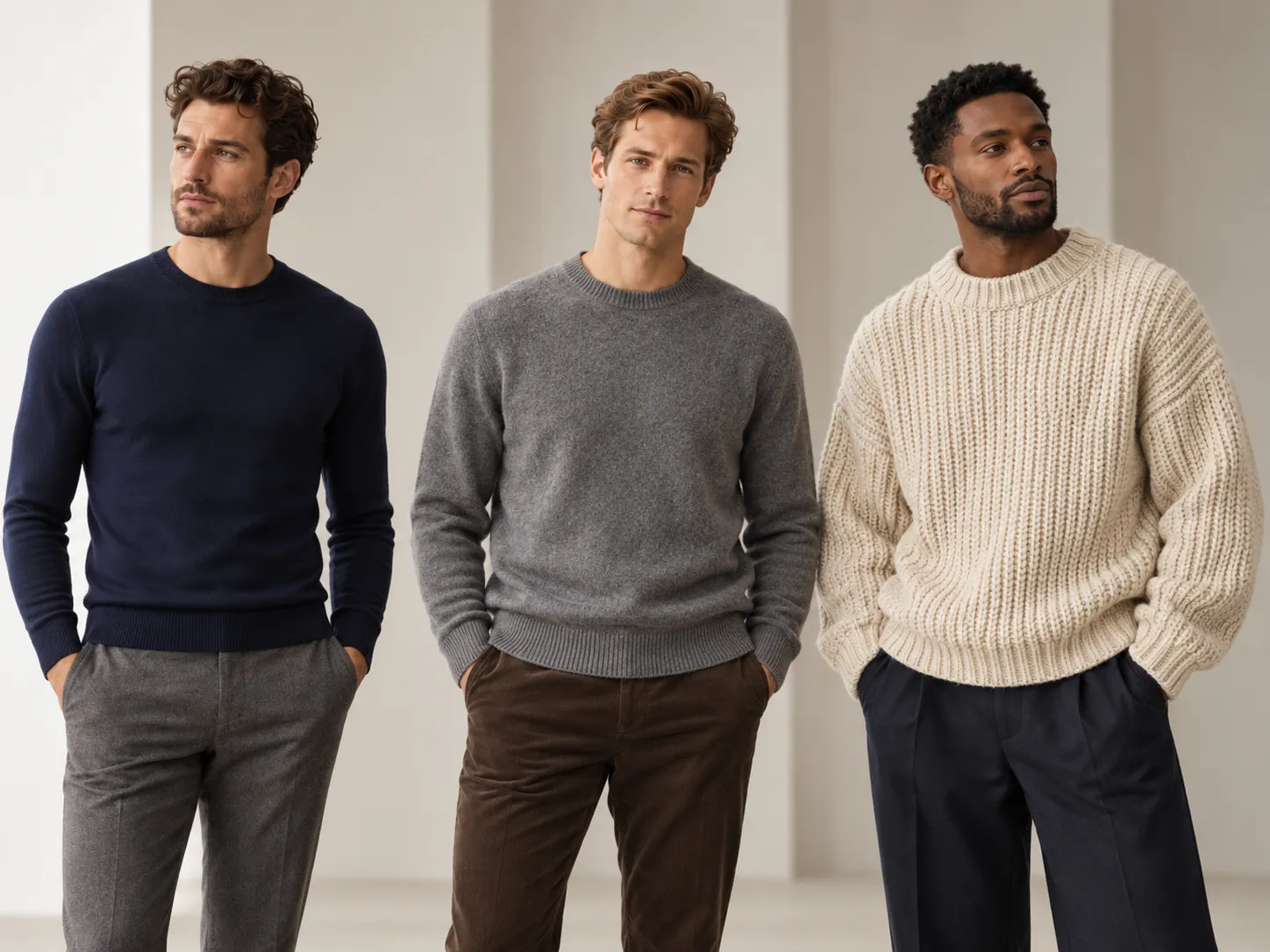
Chunky sweaters use thicker yarn and a visibly heavier knit. They provide texture and insulation but take up much more space beneath outer layers. Best for: Cold weekends and casual winter outfits Wear with: Straight-leg trousers or jeans and substantial footwear. Don’t: Force a chunky knit beneath a slim blazer.
25. Knitted Hoodie
A knitted hoodie combines sweater construction with a hood. It adds more texture than a standard sweatshirt while staying firmly casual. Best for: Weekends, travel and remote-working days Not ideal for: Traditional business-casual offices
Don’t Confuse These Sweater Types
If you’re learning different types of sweaters names, this section may save you more time than memorising another 50-item list.
| Often confused | Actual difference |
|---|---|
| Crewneck vs pullover | Crewneck = neckline; pullover = put on over the head |
| Turtleneck vs mock neck | Turtleneck has a taller, usually folding neck |
| Cardigan vs pullover | Cardigan opens at the front |
| Quarter-zip vs half-zip | The zip extends further down on a half-zip |
| Polo sweater vs Henley | Polo has a collar; Henley normally does not |
| Cable knit vs Aran | Cable is a knit structure; Aran is a broader textured style |
| Merino vs crewneck | Merino = fibre; crewneck = neckline |
| Cashmere vs cardigan | Cashmere = fibre; cardigan = front-opening construction |
| Raglan vs crewneck | Raglan = sleeve construction; crewneck = neckline |
| Fine-gauge vs chunky | Describes knit weight/density, not neckline |
This is also why asking “How many types of sweaters are there?” cannot produce one objectively correct number.
Best Types of Sweaters for Men by Occasion
For a Business-Casual Office
Choose: Fine-gauge crewneck, V-neck, quarter-zip, polo sweater or cardigan. For a broader dress-code framework, see our business casual attire guide. Stick to easy professional colours:
- Navy
- Charcoal
- Mid-grey
- Dark brown
- Forest green
- Burgundy
- Oatmeal
Pair them with an Oxford shirt, chinos or wool trousers and loafers or Derby shoes.
Best overall office option
A navy fine-gauge crewneck is difficult to get wrong. For slightly more contemporary workplaces, a slim quarter-zip also works well.
For a Conservative Office
Go simpler: Fine-gauge V-neck or crewneck + collared shirt + tailored trousers. Skip knitted hoodies, oversized knits and loud intarsia patterns. If the office normally expects jackets and ties, a sweater should complement that level of formality rather than replace it automatically.
For Casual Friday
A quarter-zip, textured crewneck, polo sweater or cardigan gives you more freedom. Try: Charcoal quarter-zip + white T-shirt + olive chinos + suede loafers. You remain put together without looking like you’re dressed for a board meeting.
For a Date
A fitted mock neck, merino polo or fine crewneck usually produces a cleaner silhouette than bulky knitwear. Try: Dark brown mock neck + charcoal trousers + dark suede boots. Avoid sizing down excessively. Knitwear should skim your body rather than cling to every line.
For Cold Weekends
This is where chunky knitwear becomes useful. Choose:
- Cable knit
- Aran sweater
- Shawl cardigan
- Fair Isle knit
- Chunky crewneck
Pair the extra volume with trousers that have enough visual weight to balance the sweater.
Best Sweater Types for Business Casual Men
For the specific needs of a professional wardrobe, I would narrow the long list down to five particularly useful shapes:
1. Fine-Gauge Crewneck
Best all-rounder. Wear it over a shirt for the office or over a plain T-shirt at the weekend.
2. Quarter-Zip
A strong modern-office option. It works especially well in tech, hybrid and less conservative corporate environments.
3. V-Neck
Still useful when you regularly wear dress shirts and ties.
4. Knitted Polo
Excellent when you want something smarter than a T-shirt but less formal than a shirt.
5. Fine Cardigan
Useful when your workplace temperature changes throughout the day because it is easy to remove without pulling clothing over your head. If you’re building a small work wardrobe, you do not need every type of sweater on this list. Start with the styles that solve actual wardrobe problems.
Sweater Materials Explained
Sweater style and sweater material are separate things. That means you shouldn’t treat cashmere and merino as competing neckline styles.
Merino Wool
Merino is a fine wool fibre. It works well for office knitwear because it can be made into lightweight sweaters, and wool naturally regulates temperature and manages moisture. Woolmark also notes that finer merino fibres bend more readily against the skin, contributing to their softer feel. Best for: Fine-gauge work sweaters
Lambswool and Other Wool
Traditional wool provides warmth and structure, though texture varies significantly depending on fibre and construction. Best for: Crewnecks, textured winter knits and cardigans
Cashmere
Cashmere is prized for softness and warmth relative to its light weight. It works especially well for thin crewnecks, V-necks, rollnecks and cardigans. The trade-off is usually price and a greater need for careful maintenance.
Cotton
Cotton knitwear can feel lighter and less insulating than many wool knits. Best for: Spring, mild weather and men who find wool uncomfortable
Synthetic and Blended Knits
Acrylic, polyester, nylon and blends are common in affordable knitwear. Performance varies greatly depending on the blend and construction, so read the fabric label rather than assuming all synthetic sweaters behave the same way.
How Should a Men’s Sweater Fit?
The right fit depends slightly on the style, but most smart men’s knitwear should follow a few basic rules.
Shoulders
On a conventional set-in sleeve, the shoulder seam should sit close to your natural shoulder point. Raglan sweaters are different because they intentionally do not have the same shoulder seam.
Chest and Torso
You want enough room to move and, when necessary, fit a shirt underneath. But if several inches of fabric balloon around your waist, the sweater is probably too loose for a polished business-casual outfit.
Sleeves
Sleeves should generally finish around the wrist rather than covering half your hand.
Length
Most conventional sweaters should cover your waistband without extending so far that the knit resembles a tunic.
Layering Allowance
If you plan to wear the sweater over Oxford shirts, try it with a shirt underneath before deciding on the fit. A sweater that looks perfect over a T-shirt may feel too tight once you add another layer.
How to Choose the Right Type of Sweater
Instead of asking which sweater is “best”, work through four questions.
1. Where Are You Wearing It?
Formal/business casual: Fine-gauge crewneck, V-neck, polo, cardigan, quarter-zip. Smart casual: Mock neck, turtleneck, textured crewneck, shawl cardigan. Casual: Chunky knit, Fair Isle, knitted hoodie, waffle knit.
2. What Will Go Under It?
Over a shirt, you need enough room in the neck and torso. Over a T-shirt, you can choose a closer fit.
3. What Will Go Over It?
If you plan to add a blazer or business-casual suit, choose thin knitwear.
If the sweater itself is your main outer layer, cable knits and chunky styles become more practical.
4. What Weather Are You Dressing For?
For a cool UK office, fine merino or cotton knitwear may be enough. Our winter business casual guide covers colder office layering. For a cold commute, heavier wool or layered knitwear makes more sense. Wool naturally manages heat and moisture, which is one reason it works effectively as a mid-layer.
UK vs US Sweater Names
One small terminology difference causes plenty of confusion online.
| UK term | Common US equivalent |
|---|---|
| Jumper | Sweater |
| Pullover | Pullover/sweater |
| Roll neck | Turtleneck |
| Polo neck | Turtleneck |
| Cardigan | Cardigan |
| Sweater vest | Sweater vest |
The biggest trap is jumper. In British English, a jumper is a knitted top. In American English, “jumper” can refer to a different sleeveless garment worn over another top, while sweater is the usual term for knitwear. For BusinessCasualMen.co.uk, using sweater in SEO headings makes sense because that is the search term you are targeting, while mentioning jumper naturally in the body serves UK readers.
Frequently Asked Questions
What are the different types of sweaters?
Common types include crewnecks, V-necks, cardigans, turtlenecks, mock necks, quarter-zips, polo sweaters, sweater vests, cable knits, Fair Isle sweaters and shawl-collar cardigans. Sweaters can also be classified by knit pattern, sleeve construction, fit and material, so the categories often overlap.
How many types of sweaters are there?
There is no fixed universal number. You can categorise a sweater by its neckline, opening, knit pattern, material, sleeve design, and fit. This is why one guide may list 20 types while another lists 40 or 50.
What are the best types of sweaters for men?
For most men’s wardrobes, the most versatile choices are a crewneck, quarter-zip, cardigan, turtleneck and V-neck. A professional wardrobe especially benefits from lightweight, fine-gauge versions that layer well under coats or blazers.
What types of sweaters do men wear to the office?
Fine-gauge crewnecks, V-necks, quarter-zips, knitted polos and cardigans work particularly well in business-casual offices. Navy, grey, brown, and other muted colours pair easily with Oxford shirts, chinos, and wool trousers.
What is the difference between a jumper and a sweater?
For UK readers, jumper is a normal term for the knitted garment Americans typically call a sweater. The words therefore overlap significantly, although regional usage differs.
Is a cardigan a type of sweater?
Yes. A cardigan is a sweater or knitted upper garment that opens or fastens at the front rather than being pulled entirely over the head.
Is cashmere a type of sweater?
Cashmere is better understood as a material, not a sweater shape. You can buy cashmere crewnecks, cardigans, turtlenecks, V-necks and other styles. The same principle applies to merino wool.
What type of sweater is best under a blazer?
A fine-gauge crewneck, V-neck, turtleneck or thin knitted polo usually works best because it adds minimal bulk. Avoid forcing a chunky cable-knit sweater beneath a fitted jacket.
Final Style Notes
Learning sweater types becomes much easier once you stop treating every sweater name as the same category. Remember the basic system: Crewneck and V-neck describe necklines. Cardigan and pullover describe construction. Cable knit and Fair Isle describe texture or pattern. Merino and cashmere describe materials. Raglan describes the sleeve. For men building a practical wardrobe, start with function rather than collecting every possible style. A fine crewneck, quarter-zip and one heavier winter knit can cover a surprising number of office, weekend and smart-casual situations. Then add specialist styles such as a turtleneck, cardigan or Fair Isle knit when they fill a genuine gap in your wardrobe.
Not sure what to wear?
Use our Men's Outfit & Dress Code Generator to get a personalised outfit based on your occasion, workplace and weather.
Try the Outfit Generator →